What is a Live Hiring Room? How GetWork is Reinventing Job Interviews in India
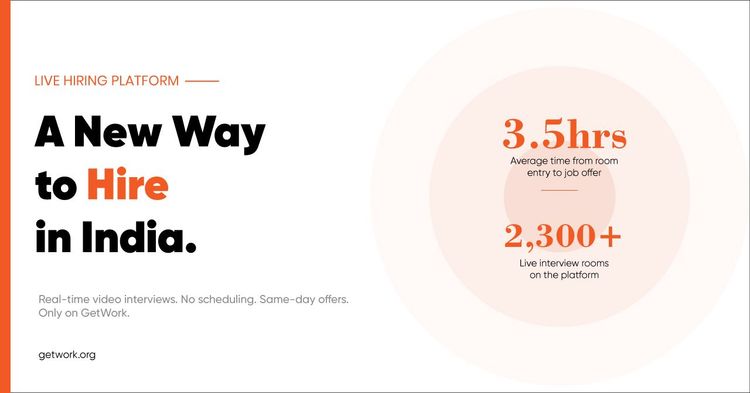
Imagine you wake up, open your phone, and by noon, you have a job offer. You don’t have to wait two months for a callback. There is no sending your resume into a void where ATS bots decide your fate before a single human reads your name. And not even three rounds of scheduling emails to confirm a video call that could have happened yesterday. That is the promise and increasingly the reality of the live hiring platform India category that GetWork is actively building. And the product driving it all is the Live Hiring Room. This isn't a buzzword or a repackaged Zoom call. It is a fundamentally different architecture for how online job interviews in India happen — one that compresses weeks of back-and-forth into a single, real-time session. Here is everything you need to know about what a Live Hiring Room is, why it exists, and how it is changing the game for India's 45 lakh+ job seekers. ~30 Average days to hire globally (SHRM, 2024) 3.5 hrs Average time-to-hire on GetWork Live Rooms 72% Of Indian employers intended to hire freshers in H2 2024 83% Of engineering graduates leave college without a job offer Why Is the Traditional Job Interview Broken for India? India's job market is one of the most active in the world. Indeed's Smarter Hiring Survey (2026) found that 46% of Indian employers reported their hiring process moving faster than twelve months ago, the highest acceleration rate of any market surveyed. Yet the ground reality for millions of freshers tells a different story. The conventional recruitment funnel in India: post a job, collect resumes, run ATS screening, schedule phone rounds, arrange panel interviews, and extend offers was designed for a world with thinner pipelines and slower communication. It was not built for a country that produces over 1.5 million engineering graduates annually, and where 83% of those graduates finish college without a job offer or internship . The bottlenecks are structural. Each stage of the traditional funnel introduces a specific failure point, and together, they create a system where talent and opportunity reliably miss each other. The market needed a live hiring platform built for India from scratch for this context. One that doesn't optimise the broken funnel, but bypasses it entirely, and GetWork built one. What Exactly Is a Live Hiring Room? A Live Hiring Room is a real-time video hiring session where verified company HRs are actively available to interview candidates, instantly, without a pre-scheduled appointment. Think of it like a walk-in interview, but online, verified, and structured. Instead of a job posting sitting on a board for 30 days, a Live Hiring Room is a live, open slot where an HR professional is ready to evaluate you in real time. You browse active rooms, pick one matching your profile, and join. The conversation starts immediately. "Skip the resume black hole. Join live video interviews with HRs actively hiring right now." — GetWork's Live Hiring Rooms. On GetWork's platform, the dashboard shows you which companies have live interview rooms open at that moment, the role, salary range, estimated wait time, and whether it's full-time, part-time, or an internship. The average wait to connect with a recruiter is 8 minutes. The average time from joining a room to receiving an offer is 3.5 hours. How Does a Live Hiring Room Actually Work? A Step-by-Step Walkthrough 1. Create your free profile on GetWork Sign up with Google or email. Add your educational background, skills, and desired roles. No paid subscription or credit card. It is 100% free for candidates. 2. Browse active Live Rooms The dashboard shows all open rooms in real time, including company name, role, salary bracket, and location. Rooms update dynamically as HRs come online throughout the day. 3. Join a room that matches your profile One click puts you in the queue. The HR receives your profile instantly without any resume upload friction, and a cover letter. Your profile does the talking. 4. Live video interview begins The session is a real two-way conversation, not a pre-recorded screening or asynchronous assessment. The HR evaluates you, you ask questions, and both sides get immediate clarity. The average wait time is 8-15 minutes. 5. Receive feedback or offer the same day Many companies using Live Hiring Rooms have the authority to extend same-day offers. Feedback on rejections is also faster because the HR just spoke to you, and there is no mystery to resolve. They provide instant feedback via email as well. How Does GetWork's Live Hiring Room Differ From Other Video Interview Platforms? Platforms like HireVue, InCruiter, VidCruiter, and SparkHire all offer virtual hiring platforms and video interview software. So what makes GetWork structurally different? The key distinction is intent and speed of action. Most enterprise video interview tools are designed to schedule and record workflow optimisation layers placed on top of an existing slow funnel. GetWork's Live Hiring Rooms replace the funnel entirely. The table below shows the feature-level comparison. The infographic goes deeper, into the philosophical difference in what each platform was fundamentally built to do. Feature Traditional Video Interview Tools GetWork Live Hiring Rooms Scheduling required? Yes, days of back-and-forth No, walk in any time ATS resume filtering? Yes, keyword-based rejection No, profile directed to HR Two-way live conversation? Partial, many use one-way async Always, synchronous video Same-day offers possible? Rare, multi-round process Yes, common outcome Free for candidates? N/A (B2B tools) 100% free Built for Indian fresher market? No Yes Verified company HR? Varies Every room, every time Who Benefits From a Live Hiring Room and How? Live Hiring Rooms are beneficial for almost everyone on both sides of the table, but for very different reasons. The value proposition isn't the same for a fresher from Coimbatore as it is for an HR at a Series B startup filling 30 ops roles before the quarter ends. The infographic below maps the specific pain point each user type enters with, and the specific gain the Live Room format delivers. The Data Behind the Demand India's entry-level job market in 2026 makes the Live Room format structurally necessary. 73% of employers intend to hire fresh graduates in H1 2026 , yet millions of graduates are still failing to break through ATS filters they never knew existed. Demand is there, but the discovery is the problem. Live Rooms solves the discovery problem by allowing candidates to interact directly with recruiters instead of disappearing into ATS pipelines. "The Live Hiring Rooms changed everything. I interviewed with 4 companies in one day and got 2 offers!” — Priya Sharma, Marketing Manager, GetWork user What Industries and Roles Are Available Through GetWork's Live Rooms? GetWork's instant job interviews India aren't limited to tech. The platform covers roles across IT, BFSI, e-commerce, sales, marketing, HR, and logistics. But the distribution is not equal, and understanding which sectors dominate Live Room hiring tells you something important about where the fast-fresher hiring India opportunity actually sits today. Sector Common Live Room Roles Typical Fresher Salary IT / Software Software Developer, Data Analyst, QA Engineer ₹4–8 LPA BFSI / Fintech Business Analyst, Relationship Manager, Credit Analyst ₹3.5–6 LPA E-commerce / Quick Commerce Operations Executive, Category Analyst, Growth Associate ₹3–5 LPA Sales & Business Dev Inside Sales, BDE, Account Executive ₹2.5–5 LPA + incentives Marketing Digital Marketing Executive, Content Writer, Social Media ₹2.5–4.5 LPA Human Resources HR Executive, Recruiter, HRBP Trainee ₹2.5–4 LPA Is the Live Hiring Room Format the Future of Recruitment in India? The indicators are convincing. India ranked second among 42 countries for hiring intent in the ManpowerGroup Employment Outlook Survey (Q4 2025) . The country is hiring at scale and speed. But the tools being used have largely not kept pace. Global enterprise platforms like HireVue, where enterprise contracts in 2026 still start around $35,000 annually and often exceed $145,000, are designed for Fortune 100 hiring workflows, not the Indian fresher discovery problem. They solve enterprise-scale interview automation, not candidate visibility and access. The real-time recruitment platform model that GetWork is innovative and contextually right for India. Because India is mobile-first, its talent pool is enormous but dispersed. The top candidates are off the market in as few as 10 days , making a 36-day cycle non-viable; and job listings prioritising skills over qualifications rose from 4% in 2023 to 14% in 2025 in India. Live conversations assess skills far better than a PDF resume ever can. How Should You Prepare for a GetWork Live Hiring Room Interview? The format is immediate, but preparation still matters, just differently. You are not preparing for a curated, rehearsed performance but are preparing for a real conversation. That distinction changes everything about how you get ready. What Else Does GetWork Offer Beyond Live Hiring Rooms? The live hiring platform India model only works when it is embedded in a broader career support ecosystem. GetWork has built five interconnected tools that don't just sit alongside Live Rooms; they actively feed into a candidate's readiness and offer conversion rates within them. The ecosystem is designed so that every product strengthens the next in sequence. The integration matters. A candidate who upskills on Aicademy, builds their profile with GetWork's builder, and completes a mock interview is measurably better prepared when they walk into a Live Hiring Room. This is not a standalone product; it is a career conversion engine where every input has a direct, live output. The Job Interview Has Been Due for a Revamp & GetWork Just Delivered It India does not have a talent shortage but has a talent discovery problem. Millions of qualified, motivated graduates and professionals exist on one side of a wall. Thousands of companies with real, open roles exist on the other side. The wall is made of outdated hiring infrastructure: ATS filters, scheduling friction, geographic bias, and the slow, impersonal machinery of the traditional recruitment funnel. GetWork's live hiring platform India tears down that wall. The Live Hiring Room is not a minor product improvement. It is a category rethink. It asks: What if the moment you were ready to be hired, someone was ready to hire you? And then it builds the infrastructure to make that true. Whether you are a fresher sending your 200th application into silence, a career changer whose resume doesn't tell the right story, or a company that cannot afford to wait 36 days to fill a critical role, the live interview platform India model exists for you. The rooms are open right now. Don't let another offer go to someone who joined earlier. Live Rooms are first-come, first-served. Yours could be waiting right now. Enter a Live Hiring Room . It’s free.