
The Hidden Cost of India's 3-Month Hiring Process (And How Freshers Pay for It)

You graduated in May. Your placement drive happened in October. You got an offer letter in January. Your joining date is "tentatively March." And now, it's already July.
Welcome to India's hiring process, where time doesn't just tick; it bleeds. Every fresher going through the job search process in India knows the anxiety of the wait. The email keeps refreshing. The unanswered follow-ups. The "we'll get back to you" that never does. But what most freshers don't realise is that this wait has a price. A measurable one: in lost income, in mental health, in career momentum, etc. And it's a price nobody warns you about before you walk off that graduation stage.
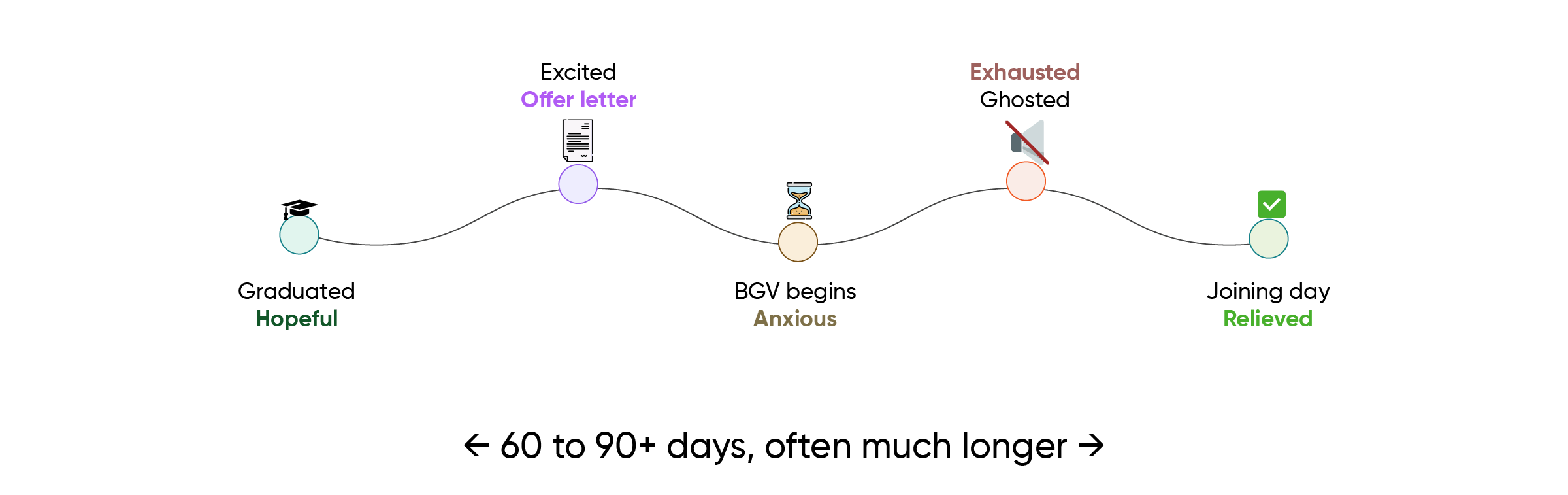
How Long Does the Process Actually Take?
Globally, average time-to-hire jumped from 36 to 44 days in 2023 to 68.5 days in 2025, according to an analysis by The Interview Guys drawing on SHRM, Greenhouse, and CareerPlug data.
For freshers in India, particularly in IT services, where recruiters have the highest share of fresh graduates, the timeline commonly stretches further.
Here's what the fresher hiring pipeline in India actually looks like:
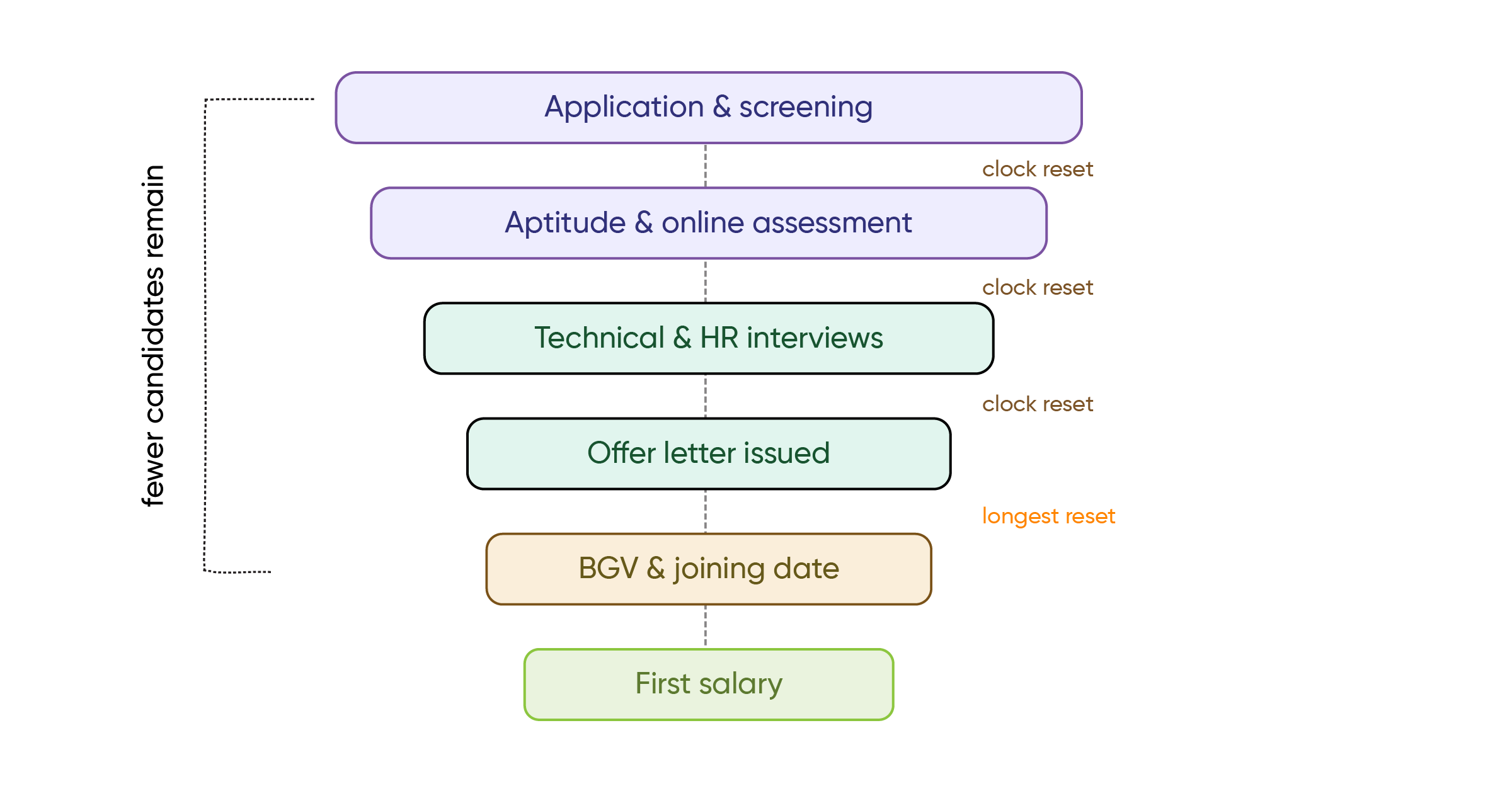
| Stage | Typical Duration |
| Application & resume screening | 1–3 weeks |
| Aptitude/ online assessment | 1–2 weeks |
| Technical interview | 1–2 weeks |
| HR interview | 1–2 weeks |
| Offer letter issuance | 2–4 weeks |
| Background verification (BGV) | 2–6 weeks |
| Joining date confirmation | 2–8 weeks (or indefinitely) |
| Total | 60–90+ days |
And those are conservative numbers. IT/ITES employee union NITES documented that Infosys kept over 1,000 engineering graduates from its 2022 batch waiting more than 2.5 years before confirming a joining date. It was finally set for October 7, 2024 (Economic Times, September 2024).
TCS freshers reported waiting up to 8 months for a joining date after receiving offer letters (Business Today, December 2022). NITES (Nascent Information Technology Employees Senate) estimated complaints of onboarding delays for 25,000 to more than 30,000 students across just two batches.
This isn't a random glitch. It's a systemic pattern, and freshers have to go through every bit of the cost.
The Three Stages That Silently Drain You
1. The Application Black Hole
Each tech job in India receives 300 to 1,000+ applications, according to Karat's 2024 analysis of India's engineering hiring funnel. And 75% of resumes are never read by a human. ATS filters screen candidates out before a recruiter ever sees their name.
The result: a 2024 LinkedIn survey in India found 73% of job seekers experienced ghosting from prospective employers, not after applying, but after interviewing. The Greenhouse 2024 State of Job Hunting Report confirms the global figure at 61%, a nine-point increase since early 2024. Most freshers navigating their job search in India will be ghosted repeatedly.
2. The Assessment Treadmill
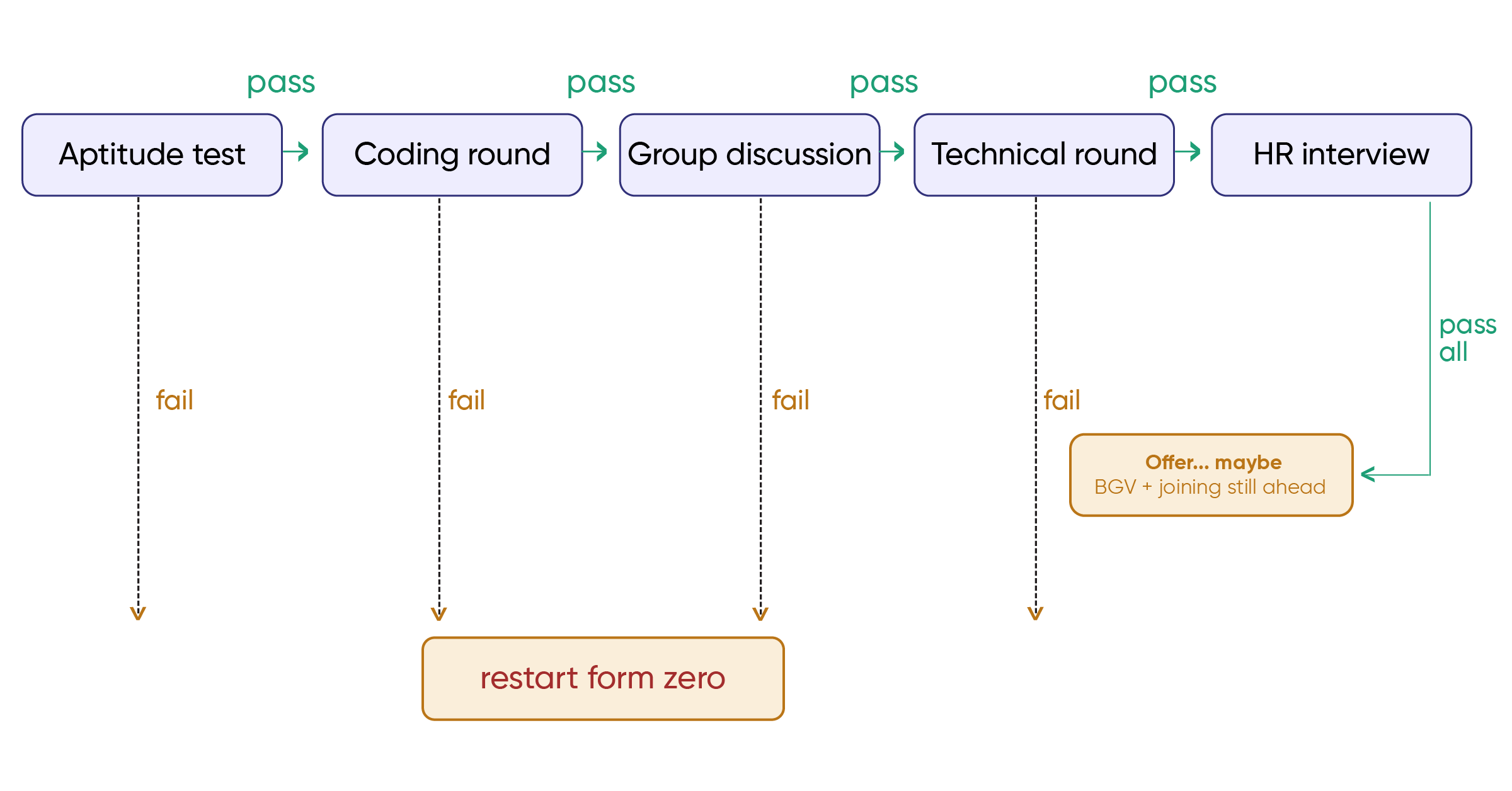
Shortlisted candidates face a rigorous process: aptitude tests, coding assessments, group discussions, technical rounds, HR rounds, and sometimes more. Capgemini's own recruitment page acknowledges this "typically takes a few weeks to complete", with the catch that "timelines may vary." Five or six such stages, each taking a few weeks, can stretch the fresher job search India time to 3-6 months before a single offer lands.
3. BGV, The Final Delay Nobody Talks About
Background verification is the most uncertain stage. After an offer letter is issued, third-party BGV checks add another 2–6 weeks. Glassdoor and Grapevine forums are full of freshers who received offer letters in April and were told "BGV is pending" through November, with joining dates shifting week by week.
An offer letter is not a job. It is a promise that India's hiring system has shown it can hold, delay, or revoke.
The Real Bill: What 3 Months of Waiting Costs a Fresher
This is the math that no career counsellor runs.
Glassdoor data (March 2026) puts the average fresher salary in India at INR 2.75 LPA, with city-specific averages at INR 4.16 LPA in Bengaluru and INR 3.89 LPA in Delhi NCR (foundit Fresher Hiring Trends Report 2024).
Using a conservative INR 3.5 LPA, roughly INR 29,000 per month, the 3-month waiting cost:
| Cost of Waiting 3 Months | Amount |
| Lost income opportunity | INR 87,000 |
| Job search expenses (travel, test prep, attire) | INR 10,000–25,000 |
| Estimated total | INR 1,00,000–1,15,000 |
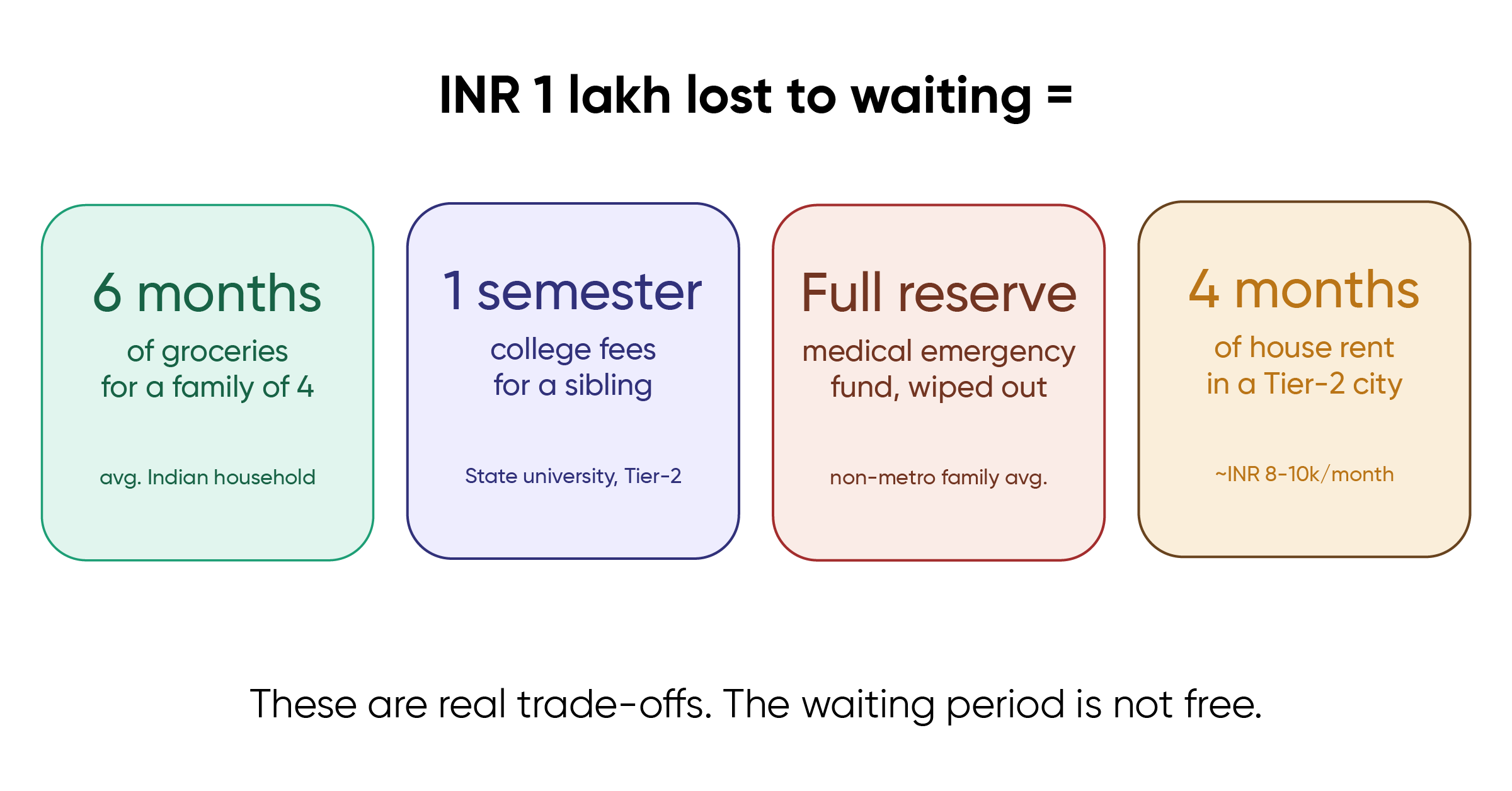
For families where parents earn barely or are non-earning, this isn't a rounding error. This is an EMI, someone's school fees, or even the family's emergency reserve.
For freshers waiting for 6 to 12 months after an offer letter, which thousands do, the figure triples. And unlike a company's revenue dip, the fresher's lost time is permanent.
The Mental Health Cost Nobody Invoices
The financial damage has numbers. The psychological damage doesn't, but it's equally real.
A peer-reviewed study published in Scientific Reports (Nature, May 2024), based on 400 graduate-level migrant youth in Kolkata, found unemployment linked with 54.4% depression, 61.8% anxiety, and 47.9% stress in the sample, with unemployed status as a key risk factor over their employed peers.
The ILO's India Employment Report 2024 (published with the Institute for Human Development) adds structural weight: India's youth make up 83% of the country's unemployed, and the unemployment rate among graduates (29.1%) is nearly nine times higher than among those who cannot read or write (3.4%). The more educated you are in India, the harder it is to find a job, statistically.
The wait also carries social weight unique to India: family expectations, relatives asking at every gathering, the comparison to peers who "got placed." The Indian Journal of Psychiatry (2024) notes that prolonged unemployment leads to "a perceived sense of failure to meet societal standards", a pattern that hits freshers intensely.
Who Pays the Highest Price?
Not all freshers wait equally. The burden is sharper for:
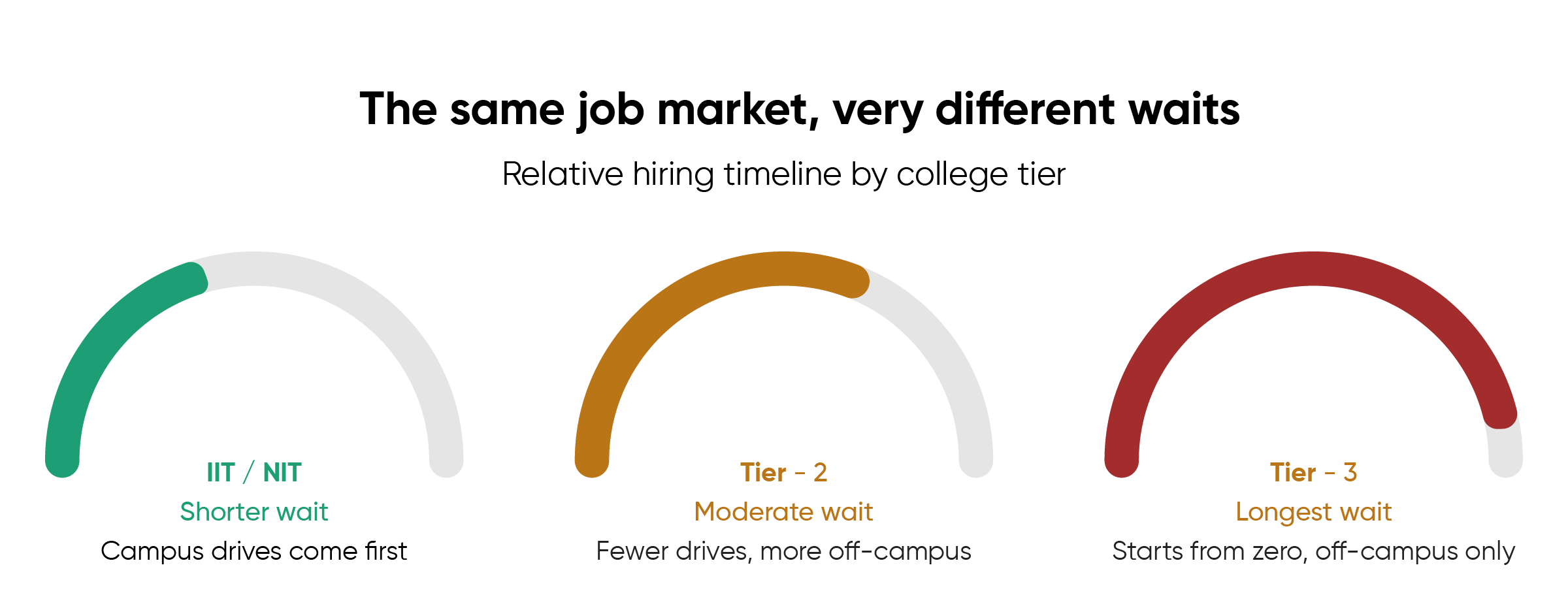
- Tier-2 and Tier-3 college graduates: Campus drives reach IITs and NITs first. Everyone else starts from zero, off-campus.
- Women freshers: The ILO 2024 report found the unemployment rate among female graduates at 34.5%, versus 26.4% for male graduates. Women accounted for 76.7% of the educated unemployed youth pool.
- Non-metro freshers: The highest fresher hiring intent is concentrated in Bengaluru (69%), Mumbai (58%), and Chennai (51%), per TeamLease EdTech's H1 2024 Career Outlook Report. Freshers elsewhere must either relocate or compete for a narrower set of roles.
What You Can Actually Do About It
The system won't change overnight. But your strategy within it can.
Never stop your search after an offer letter. Until you've received your first salary, keep applying. Companies across India like Wipro, Infosys, Tech Mahindra, Capgemini, and others have revoked or indefinitely held offer letters at scale. An offer letter is a promise. Treat it as one, but not as the finish line.
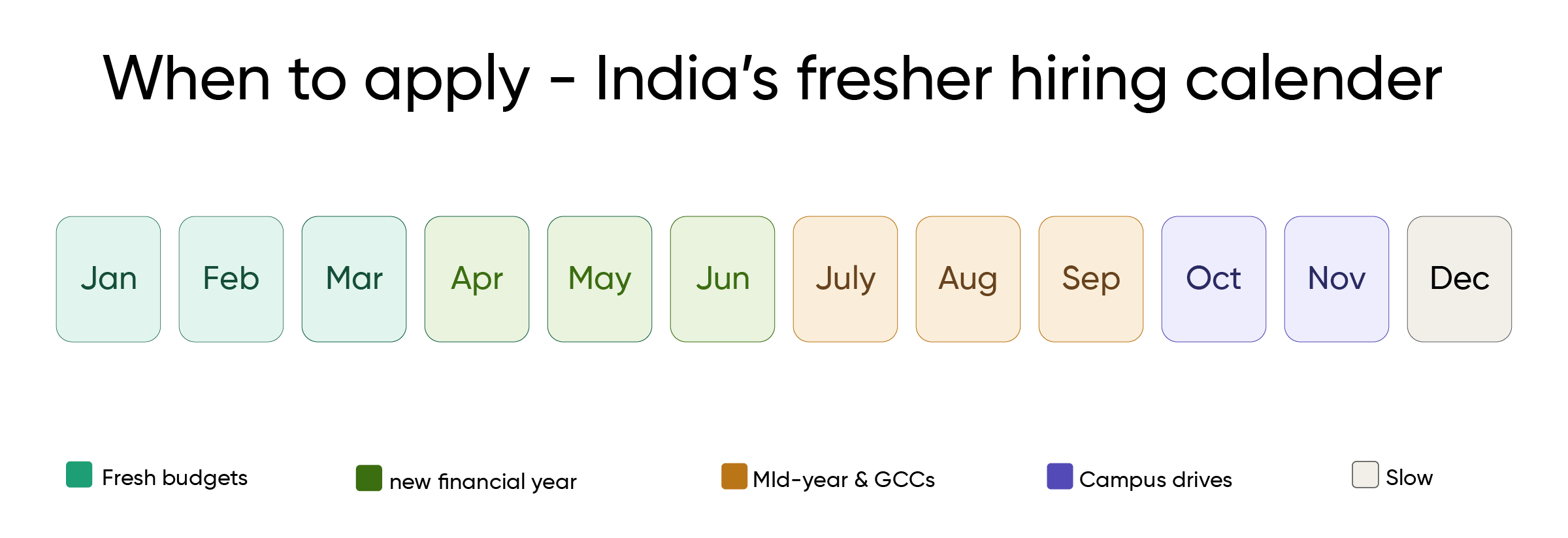
Apply in hiring windows, not all at once. The strongest periods for fresher job searches in India are January to March (fresh budgets), April to June (new financial year), and July to September (mid-year cycles). Timing your applications to these peaks improves your odds of landing in an active pipeline rather than a frozen one.
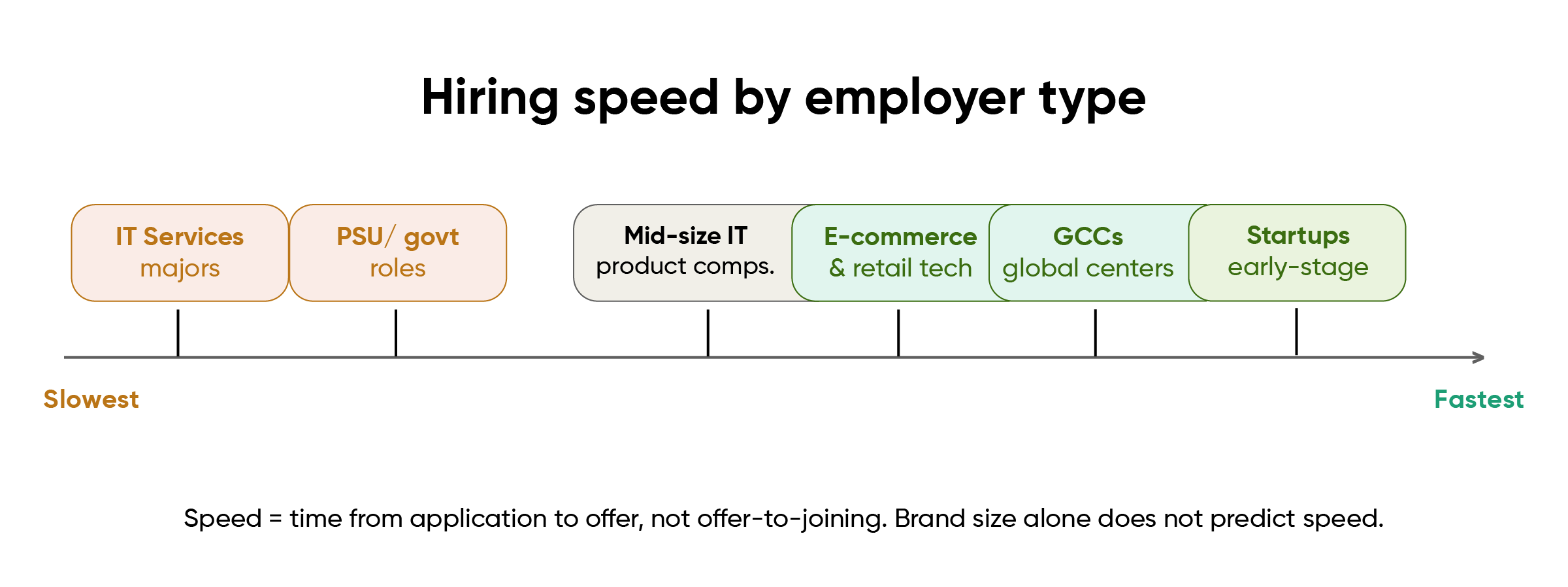
Target sectors with faster cycles. GCCs (Global Capability Centres) are projected to drive fresher hiring by 18-27% annually (TeamLease Digital via TOI, December 2025). E-commerce, retail, and tech startups are also moving faster than legacy IT services firms. Brand recognition doesn’t guarantee hiring speed.
Build skills inside the waiting period; don't just survive it. Every month of fresher job search India time that passes without learning compounds the problem. GetWork's AIcademy offers AI-powered courses and certifications, using the wait time to build skills that close the gap between applications and callbacks.
Shorten the pipeline where you can. Much of the delay comes from the layered distance between a candidate and the person actually making the hiring decision. GetWork's Live Rooms work differently. Freshers join live video sessions with HRs actively interviewing in real-time, skipping weeks of ATS filters, follow-up silence, and scheduling lag.
It won't replace preparation, but it can collapse the gap between "I applied" and "I interviewed" from weeks to hours.
One Last Thing
The companies will move on to the next batch. HR teams will fill other roles. The system will keep running on its own timeline.
But your career? That clock is yours.
The freshers who come out ahead aren't the ones who got lucky with the fastest recruiter. They're the ones who understood exactly how the system works, refused to make one application their entire strategy, and used every resource available. Skills, timing, platforms, and data to shorten the distance between just graduated and now employed.
Don't wait for India's hiring process to get faster. Get smarter at working around it.
Frequently Asked Questions
Based on industry data, the fresher job search in India typically takes from 60 to more than 90 days from first application to joining date, and often longer in IT services. The average global time-to-hire reached 68.5 days in 2025 (The Interview Guys, 2025), but Indian freshers frequently face additional delays in offer letter issuance, background verification, and joining date confirmation that push the timeline well past three months.
Unfortunately, yes, and the data backs it up. NITES (Nascent Information Technology Employees Senate) documented delays affecting an estimated 30,000 freshers across two IT hiring batches. Infosys kept 1,000+ graduates waiting 2.5 years; TCS freshers reported up to 8-month delays post-offer (Business Standard, Business Today, 2022–2024). BGV checks alone add 2 to 6 weeks. The best way is to never halt your job search before joining, even after receiving an offer letter and to keep other processes running in parallel.
The three strongest hiring windows for freshers in India are January–March (companies activate fresh annual budgets), April–June (the new financial year triggers planned hires), and July–September (mid-year cycles, especially for startups and GCCs). December is typically the slowest month, with budgets being finalised and decision-making on pause. Campus hiring drives for the following year usually begin in July–October.


0

