
Why Is Your Resume Rejected Before a Human Sees It?

You spent three hours perfecting your resume. You wrote, rewrote, asked a friend to check it, or maybe even paid someone on Fiverr to format it. Then you hit "Apply" on Naukri and LinkedIn. Once, twice, sixty times and heard nothing back. Not even a polite rejection.
Here's the truth nobody tells you about why your resume is rejected in India. In most cases, your resume never reaches a human being.
The Invisible Filter Between You and the Recruiter
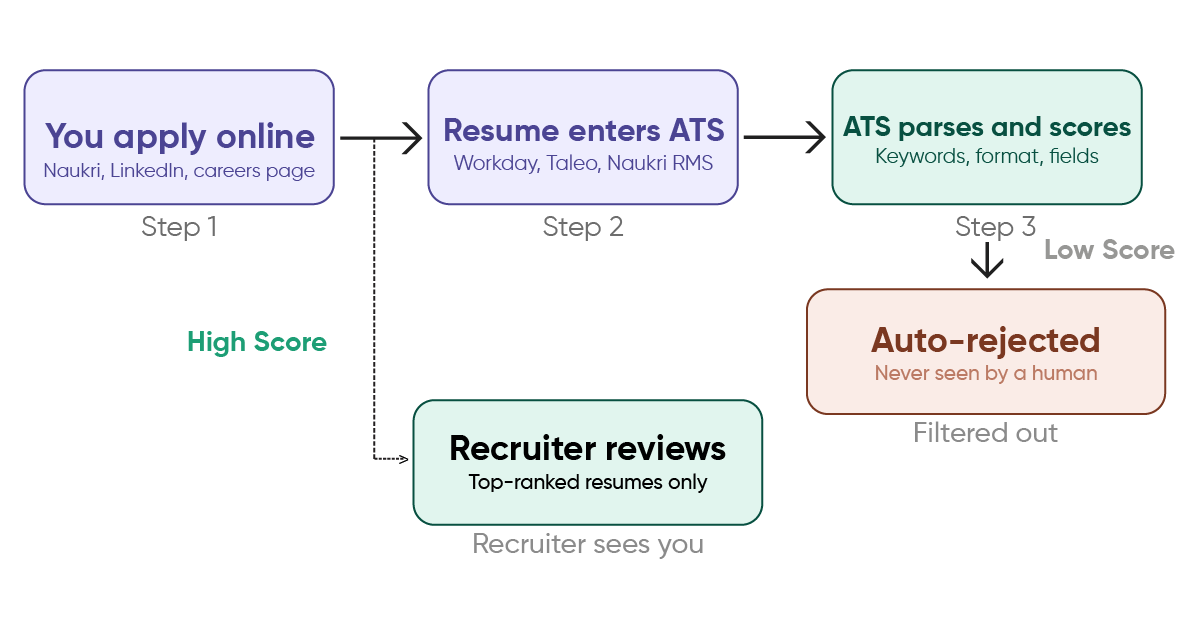
When you apply online for a job in India, your resume doesn't reach a recruiter's inbox directly. It lands inside a software: Applicant Tracking System (ATS). It filters, sorts, and ranks resumes before any human gets involved.
Today, almost 95% of Indian companies use ATS to screen resumes. Nearly 99% of Fortune 500 companies use ATS platforms on a regular basis.
The competition it is filtering? Enormous. On average, a job posting on LinkedIn India receives 200+ applications within 48 hours, and only about 13% of candidates report hearing back. Naukri, India's largest job platform, holds a database of approximately 10.6 crore resumes (as of FY 2025) across all industries and experience levels.
When a recruiter has 500+ applications and four open roles, they're not reading each resume manually. The ATS filters and ranks them. Any resume that doesn’t score well never gets seen. This is not a rejection. It's an erasure.
The critical point is 88% of employers in a global study think that their ATS filtered out highly skilled candidates. It was not because they lacked skills, but because their resume did not match the exact job criteria the system was looking for.
Source: Harvard Business School & Accenture, "Hidden Workers: Untapped Talent," 2021 (Read the report)
You may be the right candidate. Your resume just didn't speak the correct language.
5 Reasons Why Your Resume Gets Filtered Out
Your Resume Format Is Breaking the System
This is the #1 silent killer for Indian freshers, and almost nobody talks about it.
Canva templates look stunning to the human eye. To an ATS, they're a disaster. Instead, focus on using the best resume templates for freshers that are simple, text-based, and ATS-compatible. Multi-column layouts, text boxes, icons, decorative borders, and graphics are either misread or skipped entirely. The ATS extracts text from your file. If that text is locked inside a designed element, it simply doesn't exist to the system.
The data is stark: a plain DOCX file has just a 4% parsing failure rate. A single-column layout achieves 93% parsing accuracy versus 86% for two-column layouts. Text boxes, tables, and multi-column formats dramatically increase your odds of being misread or ignored.
Source: EDLIGO analysis, 2025, 1,000 rejected resumes across Workday/Taleo/Greenhouse
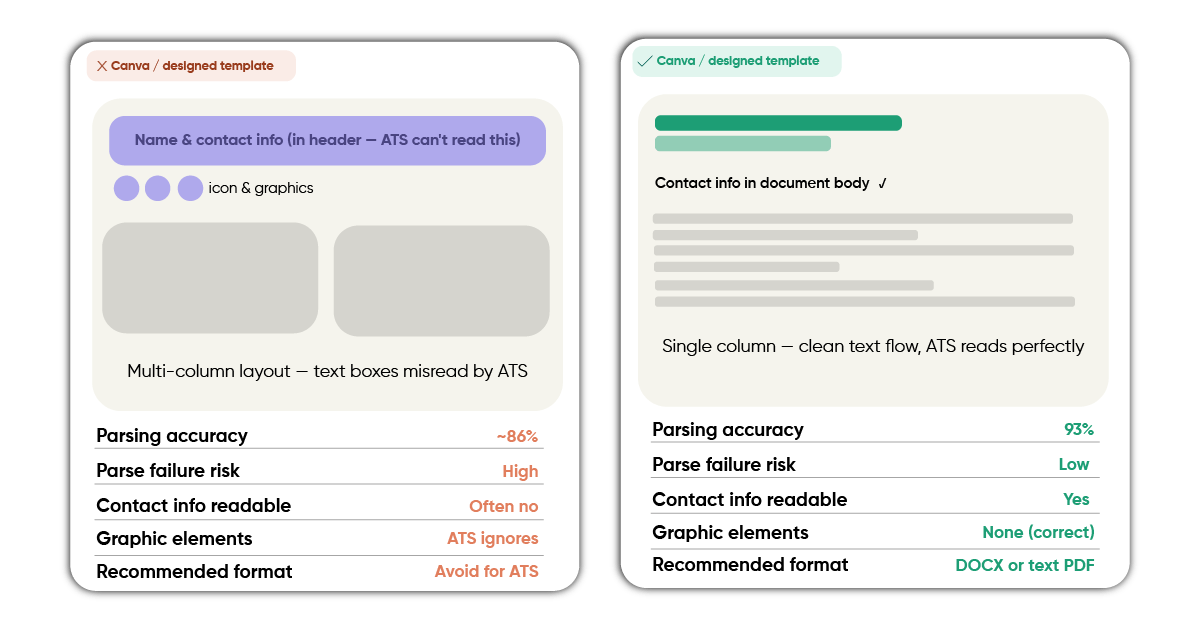
Fix: Use a clean, single-column ATS-friendly resume format in standard font. Export from Google Docs or MS Word, not Canva. Save as a text-based PDF or DOCX.
You're Not Matching the Exact Keywords
ATS doesn't interpret. It matches.
If the job description says "React.js Developer" and your resume says "Frontend Engineer," the system may not connect them. If the JD says "Microsoft Excel" and you've written "MS Excel" or just "Excel," that can register as a mismatch. ATS systems don't "understand potential." They understand keywords. Exact matches matter; abbreviations, synonyms, and paraphrasing might all cause ATS to miss your skills entirely.
Harvard's lead researcher on the Hidden Workers report advises job seekers to use the exact phrases from the job description, not add nuance, not paraphrase, but mirror the language precisely.
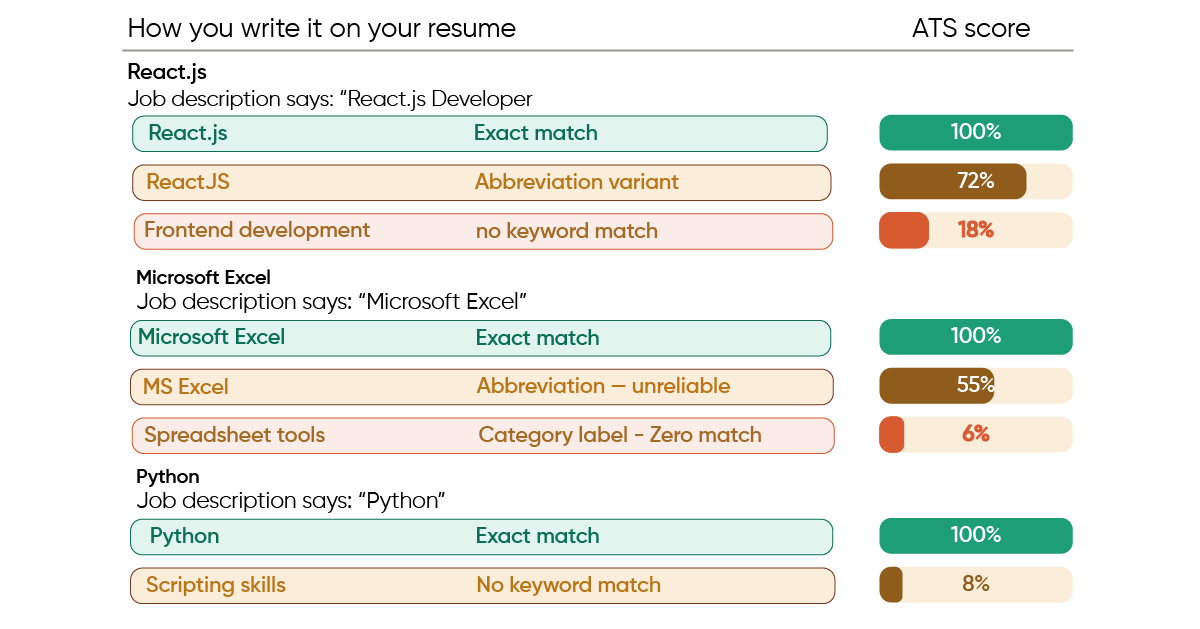
Fix: Read each job description carefully and learn how to optimise resume keywords by mirroring its language exactly. Tool names, job titles, skill names, word-for-word in your resume. A software engineer applying for a "Python Developer" role should write "Python" explicitly, not assume "scripting skills" count.
Your Contact Info Is in the Header (And the ATS Can't Read It)
This is a technical trap most freshers never discover.
25% of ATS platforms skip content placed inside document headers and footers entirely. Many popular resume templates place your name, phone number, and email in the document header, which is where they look great. But where ATS ignores them. If your contact information isn't parsed, a recruiter who finds your resume can't reach you.
Fix: Place all contact details, name, phone, email, LinkedIn URL, in the main body of the document, not in a header or footer field.
Your Summary Is Generic, and Your Bullet Points Have No Numbers
These two issues compound each other and affect your ATS score and human review simultaneously.
In India, millions of resumes still open with: "I am a highly motivated, hardworking individual seeking a challenging role where I can grow." This sentence has zero keyword value and tells a recruiter (or an AI scoring system) nothing about your actual capabilities.
Similarly, bullets like "Responsible for marketing campaigns" or "Worked on backend development" give no signal of impact or scope.
83% of recruiters confirm they're more likely to hire candidates who tailored their resume to the specific job they're applying for. Understanding how to quantify resume bullet points is critical. Quantified bullets, such as "Built a React app used by 10,000+ users" vs. "Worked on a web application", also increase your chances significantly.
For freshers specifically, academic projects, certifications, internship contributions, and college achievements can absolutely be evaluated. Don't skip the numbers just because you don't have full-time experience.
Fix: Replace your generic objective with a 3-line keyword-rich summary that names your domain, top 2 to 3 skills, and what you're looking for. Add a number to every bullet point where possible.
You Applied Too Late, or Used the Same Resume for Everything
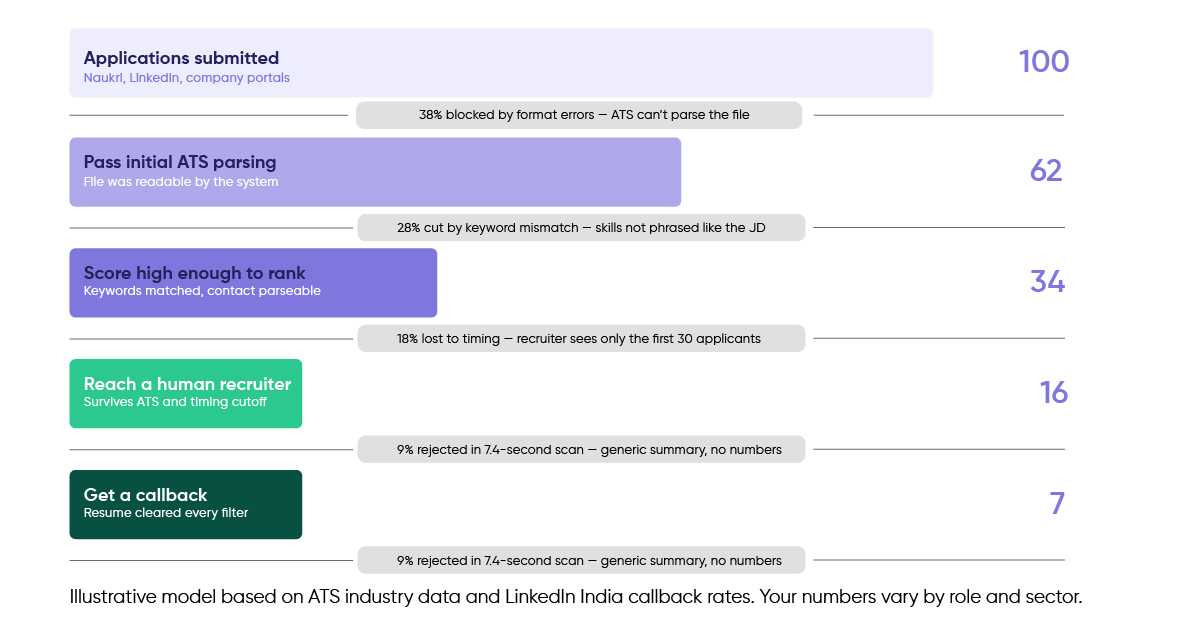
When more than 200 people apply to the same role and a recruiter only looks at the first 30, being ranked #115 is practically the same as being rejected. Timing affects your rank. Applying within the first 24-48 hours of a job being posted consistently outperforms applying days later. Platforms like GetWork help you discover verified, actively hiring roles early, so you're not competing after the pipeline is already saturated.
And a single generic resume for every job is one of the most costly habits in a fresh job search. Every job description configures the ATS differently. A resume optimised for "Data Analyst at a fintech company" may score poorly for "Business Intelligence Engineer at an IT firm", even if your actual skills are identical, simply because the keyword weights differ.
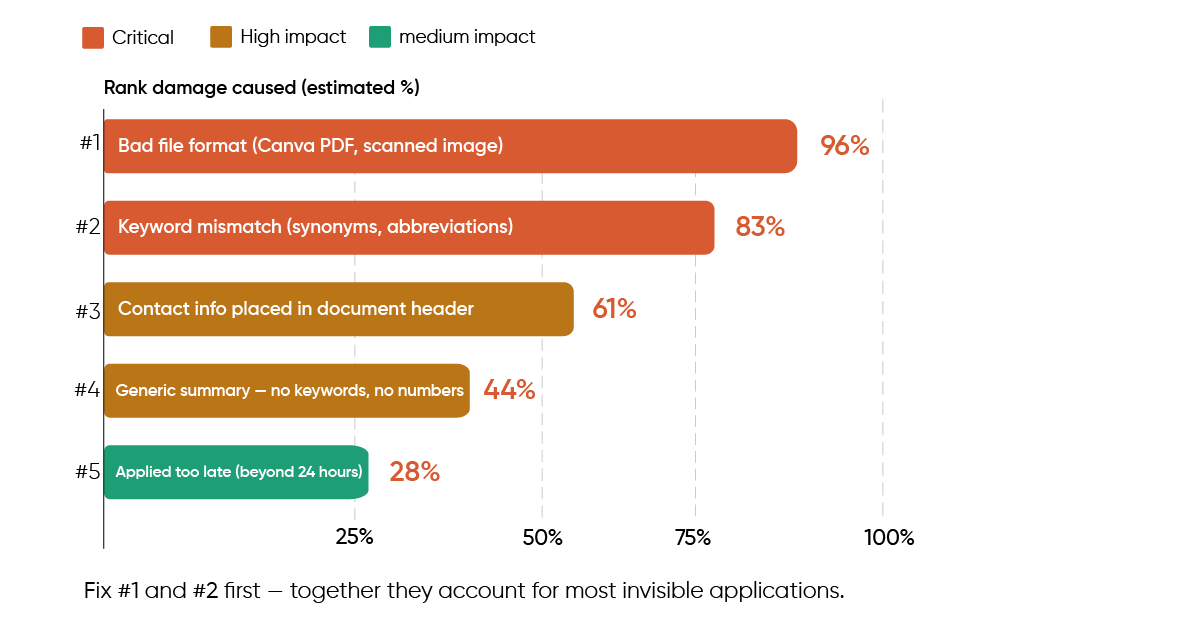
Fix: Set job alerts. Apply early. Keep a strong master resume and make targeted adjustments (headline, skills section, summary) for each role you apply to.
If You Pass the ATS: The 7.4-Second Human Scan
Let's say your resume survives the ATS filter. Now it reaches a recruiter. What happens next?
According to TheLadders' 2018 eye-tracking study, recruiters spend an average of 7.4 seconds on their initial scan of a resume. In that first pass, eye-tracking data shows they follow an F-pattern: across the top of the page, then down the left side. They're looking for your name, most recent role, key tools/skills, and any numbers that signal impact.
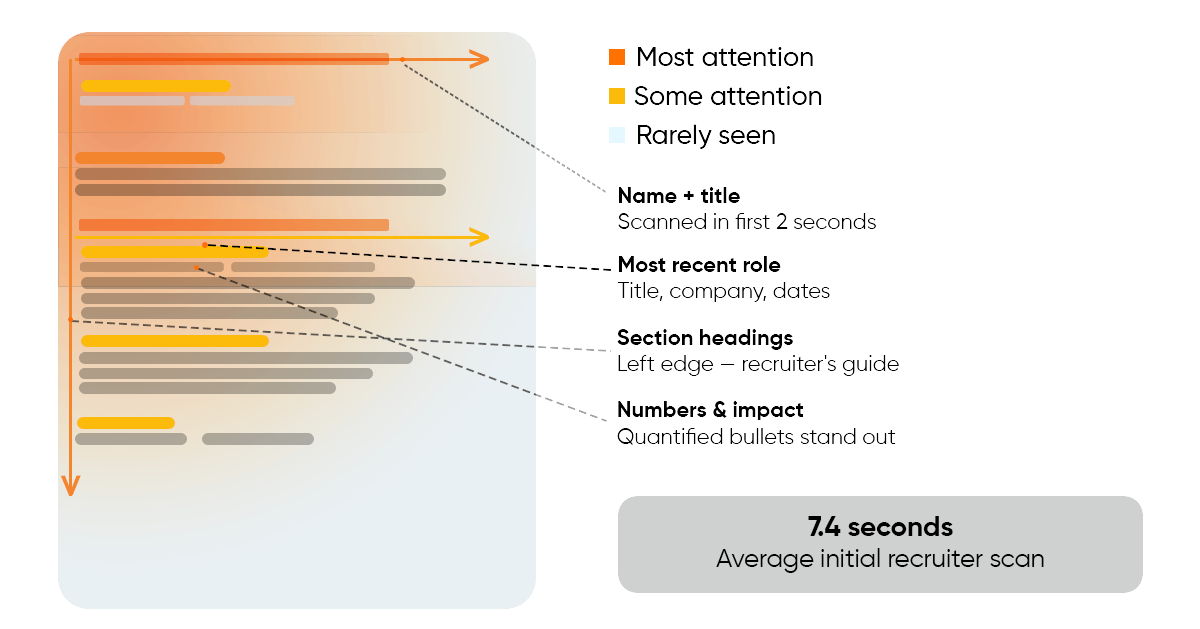
Resumes that succeeded in capturing the recruiter's attention featured simple layouts with clear sections and heading titles. Resumes with cluttered layouts, multiple columns, and long sentences performed poorly.
The first filter is software. The second is a seven-second scan. Both reward the same thing: a clean, specific, keyword-matched resume.
Quick Pre-Apply Checklist for Freshers
Before sending your next application, check these off:
- Single-column layout, standard font (Calibri or Arial, 10–12pt)
- Saved as a text-based PDF; not a Canva export, not a scanned image
- File named: FirstName_LastName_Resume.pdf
- Contact info in the document body; not in the header or footer
- Resume headline and summary tailored to this specific role
- Skills and tools written in full, exactly as stated in the JD
- Every bullet point has an action verb + measurable result
- No photos, icons, decorative columns, or graphic elements
- LinkedIn URL included (and profile updated to match)
- Applied within 48 hours of the job posting going live
One Last Thing
The job market in India is genuinely active. Fresher hiring grew 8% year-on-year overall in early 2026, with some sectors like BPO/ITES seeing up to 39% growth, according to the Naukri JobSpeak Index. The opportunities are real. But with 10.6 crore resumes in a single database, the competition is real too.
Your resume is not your career. But right now, it's your first impression on a system that decides whether you get a chance to show what you can actually do. Fix the format. Match the language. Apply on time. Quantify your work, even if it's from a college project.
The system isn't perfect. Although once you understand how it works and why resumes are not shortlisted in India, you stop being invisible to it.
If you're a fresher or early-career professional looking for verified, active job listings in India without the noise, GetWork aggregates opportunities across industries in one place, so you spend less time searching and more time applying to the right roles with the right resume.
Frequently Asked Questions
No, not every company uses ATS for screening resumes. Small businesses and early-stage startups may still review resumes manually.
But for most organised hiring in India, including MNCs, IT companies, BPOs, e-commerce firms, product startups, banks, and large non-IT companies, ATS is the default. If you're applying on Naukri, LinkedIn, or a company's career portal, assume an ATS is involved and format accordingly.
As a fresher, focus on keywords from three areas: technical skills (exact tools, languages, frameworks mentioned in the JD), soft skills phrased as capabilities (not "team player" but "collaborated across 4-member project team"), and academic/project context (if you built something, name the specific tech stack).
For internships, describe deliverables, not just responsibilities. Check the job description, identify the 5–8 most important terms, and make sure they appear naturally in your resume. If the job says "Python," write "Python" and not "programming language" or "coding skills."
Before sending application #101, pause and audit your resume for the five issues: format, keywords, contact info placement, generic summary, and lack of quantification. Then run your resume through a free ATS checker (Jobscan or Resume Worded offer free scans) against 2–3 specific job descriptions you want to apply for.
Most freshers who do this discover their resume is scoring below 50% on keyword match, not because they're unqualified, but because the resume wasn't written for the ATS. This is the reason why resumes are not selected in India. Fix the fundamentals first. Then apply.
Also, make sure you're applying to active and verified openings through platforms like GetWork to avoid wasting effort on outdated or inactive listings.


0

