
HR Career in 2026: Do You Still Need a Degree or Just These Skills?

The human resources rulebook has been rewritten. Before you spend four years and a fortune on a degree, read this.
Imagine two candidates walk into an HR interview. One has a shiny Bachelor's degree in Human Resource Management and zero real-world exposure. The other has no degree but holds an aPHR certification, has spent a year managing onboarding for a 200-person startup, and can demonstrate three HR software tools from memory.
In 2020, hiring managers might have passed the second one over without a second glance. In 2026, they got the offer. The ground beneath HR hiring has shifted quietly but decisively. If you're wondering whether an HR career without a degree is actually achievable today, the answer isn't just "yes." It's that the window has never been wider, but you need to know exactly what to bring instead.
65% of employers now prioritise skills over formal education — Stand Together, 2024 | 82% of HR leaders confident about their 2026 outlook — Robert Half, 2026 | 59% say it's harder to find skilled HR talent than a year ago — Robert Half, 2026 | 70% of core job skills changing by 2030 (AI-driven) — LinkedIn, 2025 |
The Degree Question: What's Actually Changing in 2026?
For decades, a degree in HR, Business Administration, or Psychology was practically the price of entry. That convention is erasing fast, and the data proves it.
According to LinkedIn, 70% of the core skills required for most jobs are projected to change by 2030, with AI acting as the primary catalyst. This disruption hits HR especially hard because the very function of HR: finding, assessing, and retaining talent, is being rebuilt around skills evidence, not education credentials.
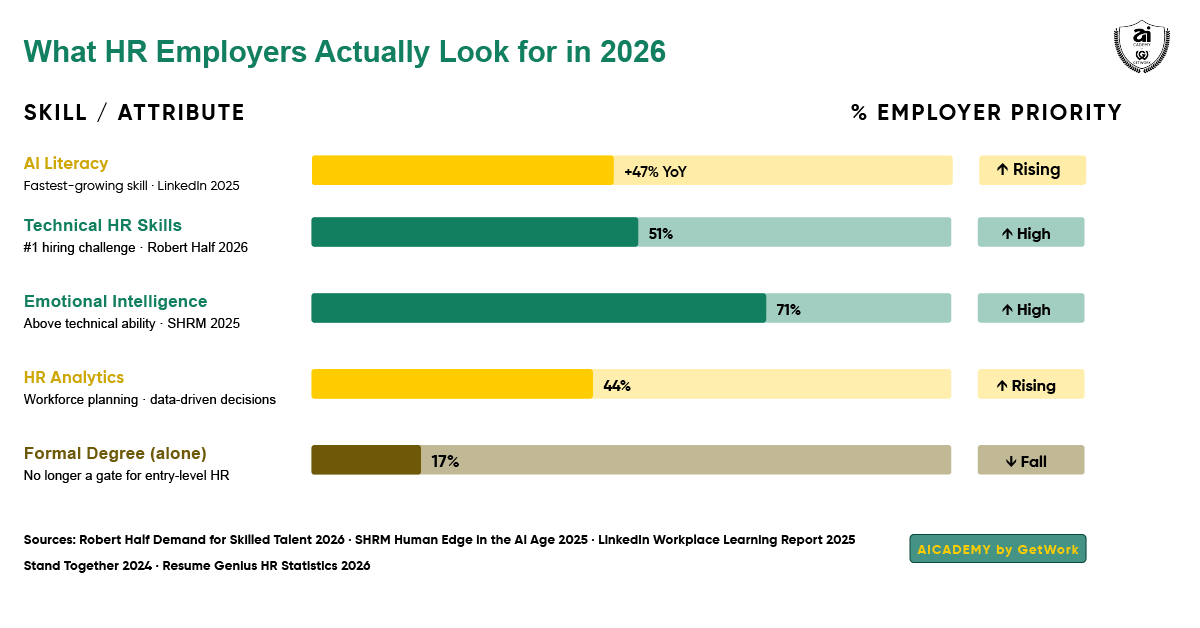
When HR professionals are asked about their biggest hiring challenges, finding candidates with the right technical skills (51%) and soft skills (45%) tops the list. The irony is significant: HR teams struggling to find skills-verified talent are now being hired the same way.
A 2025 Naukri report showed that recruiters increasingly value hands-on exposure to HR tech, AI-assisted hiring tools, communication, and stakeholder management over just an MBA or HR degree, especially for entry-level talent competing in high-volume hiring markets.
This isn't a degree-bashing article. It's a talent-supply problem forcing pragmatic solutions. The breadth of today's HR responsibilities, spanning analytics, HR technology, compliance, engagement, and workforce planning, means fewer candidates have the full mix of skills organisations seek. Degrees simply don't teach all of that anymore.
The 8 Skills That Actually Get You Hired in HR Today
In 2026, the skillset has expanded well beyond the traditional soft-skill toolkit. Here are the eight areas employers are actively testing for, none of which require a college degree to acquire:
- AI Literacy: Using ChatGPT for JD drafting, AI-assisted screening, and automated HR workflows. Demand is up 47% year-over-year per LinkedIn 2025.
- HR Analytics: Reading attrition data, headcount planning, and using tools like Excel, Power BI, or Visier to support data-driven decisions.
- Communication & Emotional Intelligence: 71% of employers rank EQ among their top desired skills above technical ability (SHRM 2025).
- HRIS Proficiency: Hands-on experience with Workday, BambooHR, Zoho People, or Darwinbox for India-based roles.
- Labour Law Basics: PF, ESI, Shops & Establishments Act for India; FLSA/ADA for US-facing roles.
- Talent Acquisition: ATS management, LinkedIn Recruiter sourcing, structured interview design, and offer negotiation.
- Conflict Resolution: Mediating employee disputes, handling grievances, and maintaining psychological safety.
- L&D Coordination: Designing onboarding journeys, mapping skill gaps, and coordinating learning programmes.
Notice what's not on that list: 'Bachelor's degree in HRM.'
HR Certifications: The Degree Alternative That Employers Actually Respect
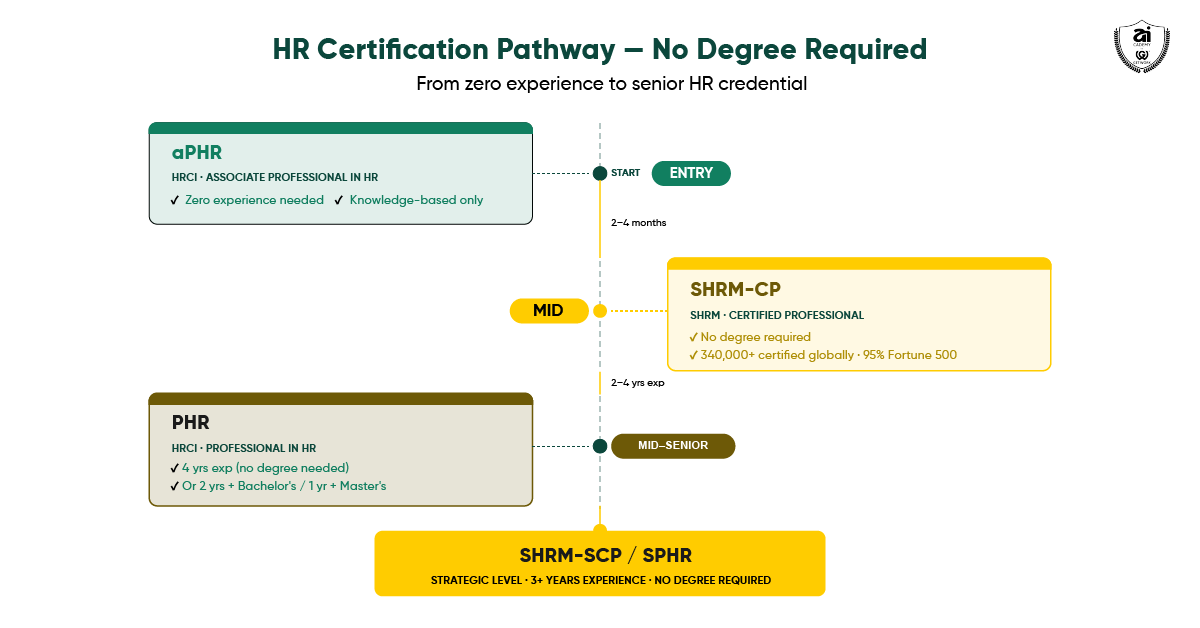
If a degree is a four-year investment, a targeted HR certification is a focused, affordable, globally recognised shortcut. Here's a breakdown of the most credible options:
| Certification | Issuing Body | Who It's For | Degree Required? | Level |
| aPHR | HRCI | Complete beginners, non-HR managers | No | Entry |
| SHRM-CP | SHRM | Early to mid-career HR practitioners | No | Mid |
| PHR | HRCI | HR pros with 2–4 yrs experience | Flexible* | Mid |
| SHRM-SCP | SHRM | Strategic-level HR leaders (3+ yrs) | No | Senior |
| SPHR | HRCI | HR executives, policy-makers | Flexible* | Senior |
| AIHR Certificates | AIHR | Specialists in analytics, L&D, DEIB | No | Specialist |
*PHR requires either 4 years of HR experience alone (no degree), or 2 years with a Bachelor's, or 1 year with a Master's.
The aPHR from HRCI requires no HR experience whatsoever. It is purely knowledge-based and the most accessible entry point. The SHRM-CP does not require a degree or HR title. With over 340,000 HR professionals and 95% of Fortune 500 companies turning to SHRM, this credential carries serious weight on any resume.
The Realistic Roadmap: Breaking Into HR Without a Degree
Here's a step-by-step route that real professionals have used to launch an HR career without a degree in India and globally.
| 01 | Build Foundational Knowledge (Month 1–2) Complete a free or low-cost online HR fundamentals course on Coursera, SHRM eLearning, or a structured platform like Aicademy by GetWork. Learn the basics of recruitment, onboarding, payroll, and compliance. |
| 02 | Earn Your First Certification (Month 2–4) Pursue the aPHR (no experience needed) or the SHRM-CP. This replaces the 'degree line' on your resume with a verifiable, respected credential. |
| 03 | Get Hands-On Through Internships or Admin Roles (Month 3–6) Work in an administrative role at an organisation and transition into HR. Even a 3-month internship gives you real cases to discuss in interviews. |
| 04 | Master at Least One HRIS Tool (Month 4–5) Get certified or self-taught on Workday, BambooHR, Zoho People, or Darwinbox. Document everything in a portfolio. |
| 05 | Build Your Network (Ongoing) Join SHRM chapter events, HR communities on LinkedIn, and NHRDN events. Professional networking has become a proven route into HR. |
| 06 | Apply Strategically to Entry-Level Roles Target HR Coordinator, HR Assistant, Talent Acquisition Associate, or People Ops Analyst roles. Quantify everything, e.g., 'Managed employee records and improved hiring efficiency by implementing an ATS.' |
How Structured Programmes Accelerate This Path
For students who prefer a structured, guided route rather than self-teaching across varied resources, programmes like the Human Resource Management with AI Program by Aicademy by GetWork are specifically designed for this scenario. The 12-week, live online programme covers the exact toolkit this article outlines from HR Analytics and HRIS tools (Zoho Recruit, Excel, ChatGPT) to employer branding and labour law compliance across 80+ hours of practical instruction.
The programme includes 4 hands-on projects (including building an HR Data Dashboard and designing a Compliance Handbook), mentorship from industry leaders with 7–14 years of HR experience, and placement support across 10,000+ hiring partners. Alumni have transitioned from teaching, BPO, and engineering backgrounds into HR roles at Google, Amazon, Deloitte, and EY.
Mention of this is purely for context, as structured training accelerates the 6–12 month timeline outlined in this roadmap. It is one of the paths, not the only path.
Roles You Can Target Right Now (With Salary Benchmarks)
HR hiring in 2026 is fuelled by organisations' need to refine talent strategies, improve performance management, and support digital transformation. Here's where to aim first:
| Role | Degree Required? | Key Skills Needed | Avg. Salary (India) |
| HR Coordinator | Often No | Scheduling, onboarding, ATS, HRIS | ₹3–5 LPA |
| Talent Acquisition Associate | Often No | Sourcing, LinkedIn Recruiter, screening | ₹3.5–6 LPA |
| HR Assistant | No | Documentation, employee queries, compliance | ₹2.5–4 LPA |
| People Ops Analyst | Preferred | HR Analytics, Power BI, HRIS reporting | ₹5–9 LPA |
| HR Business Partner (Jr.) | Preferred | Stakeholder mgmt, workforce planning | ₹6–10 LPA |
Unemployment rates for compensation, benefits, and job analysis specialists were at just 0.8% in 2025, signalling how much demand exceeds supply for verified HR talent (BLS, 2025).
Where a Degree Still Matters (Be Honest With Yourself)
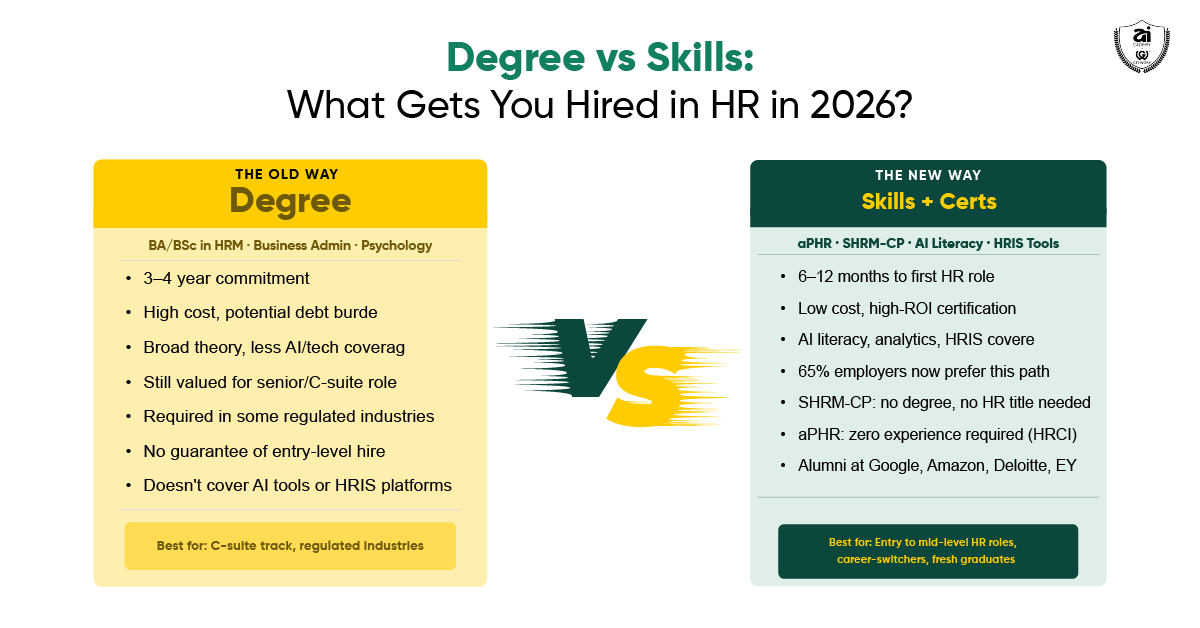
There are specific contexts where formal education still holds a measurable advantage:
- Labour Law / Industrial Relations specialisation: Deep compliance roles in manufacturing or public sector often favour formal legal or HR law qualifications.
- HR Director / CHRO-track ambitions: At the C-suite level, an MBA or Master's in HRM still differentiates candidates in large corporations.
- Academic or consulting HR roles: Research-based or policy advisory positions almost always require postgraduate credentials.
- Regulated industries: Healthcare, banking, or defence HR often carry formal education requirements due to compliance frameworks.
- Global mobility / expatriate HR: Multi-jurisdictional legal complexity often demands specialised formal training.
The honest answer:
A degree accelerates the path to senior HR leadership, but is no longer a gate for entry or mid-level practice. The smarter question is not "degree or no degree?" It's what combination of credentials, experience, and skills gets you there fastest.
The AI Factor: Why 2026 Is a Particularly Good Time to Enter HR Without a Degree
A 2025 LinkedIn Workplace Learning Report found that AI literacy ranks among the fastest-growing professional skills, with demand up 47% year-over-year. Still, less than half of employees feel confident using AI tools in their daily productivity. This gap is your opportunity.
A candidate who has spent three months learning how to use AI for resume screening, automated onboarding, or HR chatbot management is genuinely ahead of many degree-holders who have never touched these tools. C-suite executives now rank AI literacy as the single most important skillset for navigating business change.
Practical tools to learn:
ChatGPT for HR workflows, HireVue or Paradox for AI-driven interview screening, Lattice or Leapsome for performance management, and Workday AI features for workforce analytics.
Your HR Career Doesn't Start With a Degree. It Starts With a Decision. The data is clear, the certifications are accessible, and the hiring market is actively looking for skilled HR professionals, whether you have a degree or not. Explore HR Course from Aicademy by GetWork
Frequently Asked Questions
Yes, increasingly so. Indian startups and tech companies are moving toward skills-based hiring. Entry-level roles like HR Coordinator, Recruiter, or People Ops Associate regularly list a degree as 'preferred, not required.' Pair an aPHR or SHRM-CP certification with internship experience and working knowledge of a tool like Zoho People or Darwinbox, and you're eligible for most entry-level positions.
The aPHR (Associate Professional in Human Resources) by HRCI is specifically designed for people with zero HR experience. It's knowledge-based, requires no prior work history, and signals to employers that you understand foundational HR principles. Once you have 1–2 years of experience, upgrade to SHRM-CP or PHR for higher career impact.
With a focused approach with certification + online courses + internship, most candidates land their first HR role within 6 to 12 months. The aPHR exam prep typically takes 2–3 months of part-time study. Combining that with a simultaneous internship means you can enter the job market by month 6–8.
Based on Robert Half's 2026 Demand for Skilled Talent report and LinkedIn data, the most in-demand HR skills are:
- AI literacy and HR tech proficiency
- HR analytics and data interpretation,
- Talent acquisition and ATS management
- Employee experience design and emotional intelligence for conflict resolution
AI literacy is the fastest-growing gap.
Not necessarily, but an MBA can help reach the top. Many HR Directors have risen without an MBA by accumulating certifications (SPHR, SHRM-SCP), specialised skills in workforce planning or DEIB, and 8–12 years of experience. If you aspire to be at a CHRO level in a large corporation, an MBA or an Executive HR programme adds credibility.


0

