
The Fresher Job Market in India 2026: What the Data Actually Says

India produces one of the largest pools of graduates in the world every year. And the same conversation loops each year: Why can't freshers find jobs? In 2026, the data finally gives us a clear answer, and it's more nuanced than either "the market is booming" or "freshers don't stand a chance."
This is not a roundup of job board listings. This is a breakdown of what the numbers actually show about the fresher job market in India 2026: the structural gaps, the sectors hiring aggressively, the salary realities by role, and the one platform quietly solving what the traditional job search couldn't.
The Paradox:
India ranked 2nd globally in hiring intent in late 2025, with 40% of companies planning to expand headcount. Yet only 42.6% of graduates meet what employers actually need. More jobs. Fewer suitable candidates. That's the story.
The State of the Fresher Job Market: 2026 at a Glance
Before diving into sectors and strategies, here's the larger picture from authoritative sources: the India Skills Report 2026 (ETS, CII, AICTE, Taggd) and the Mercer-Mettl India Graduate Skill Index.
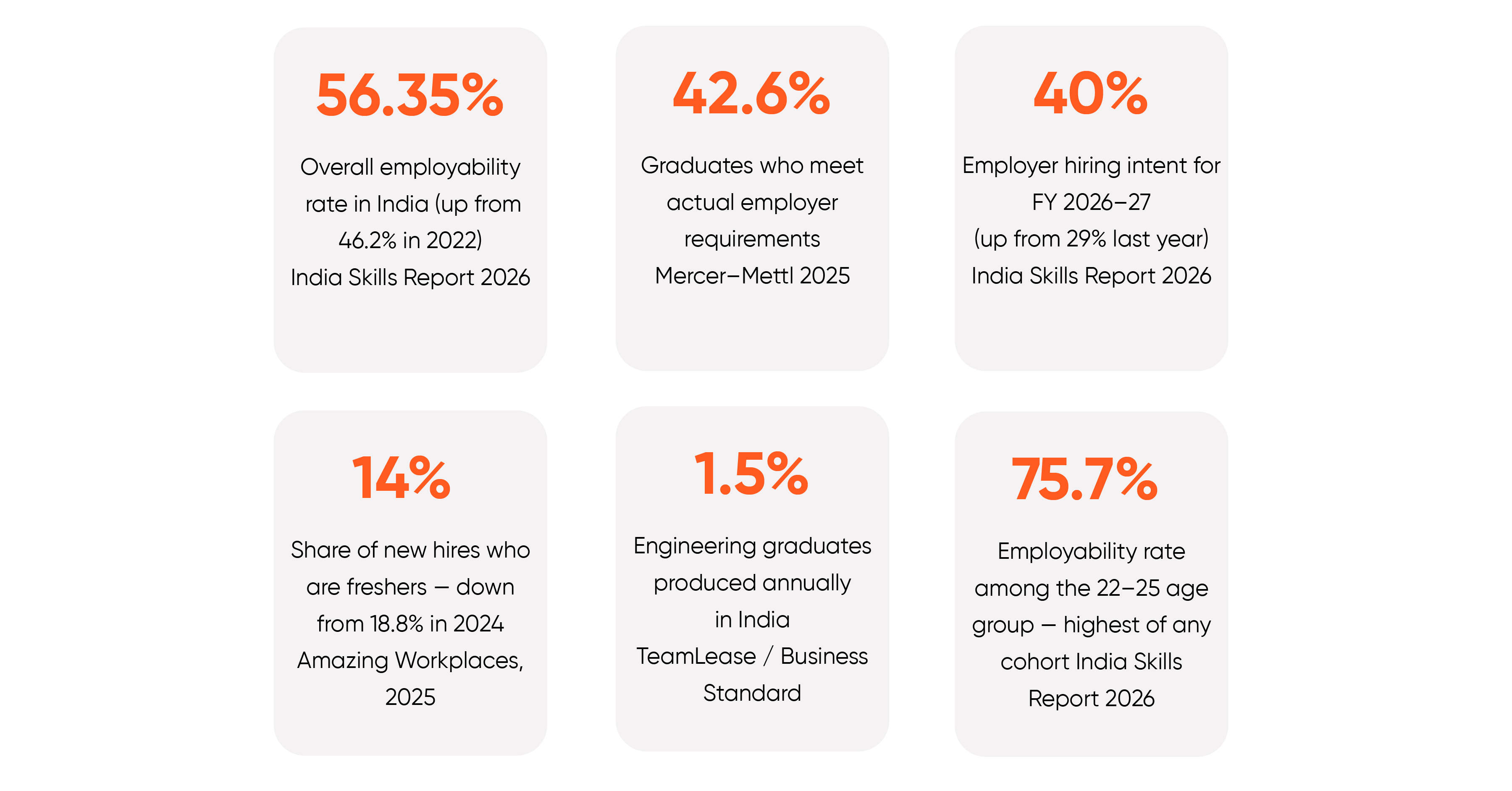
The headline number: 56.35% employability sounds encouraging. But pair it with the Mercer-Mettl finding that only 42.6% of graduates actually satisfy what companies are screening for, and the gap becomes sharp. Employability on paper vs. employability in practice is two different things.
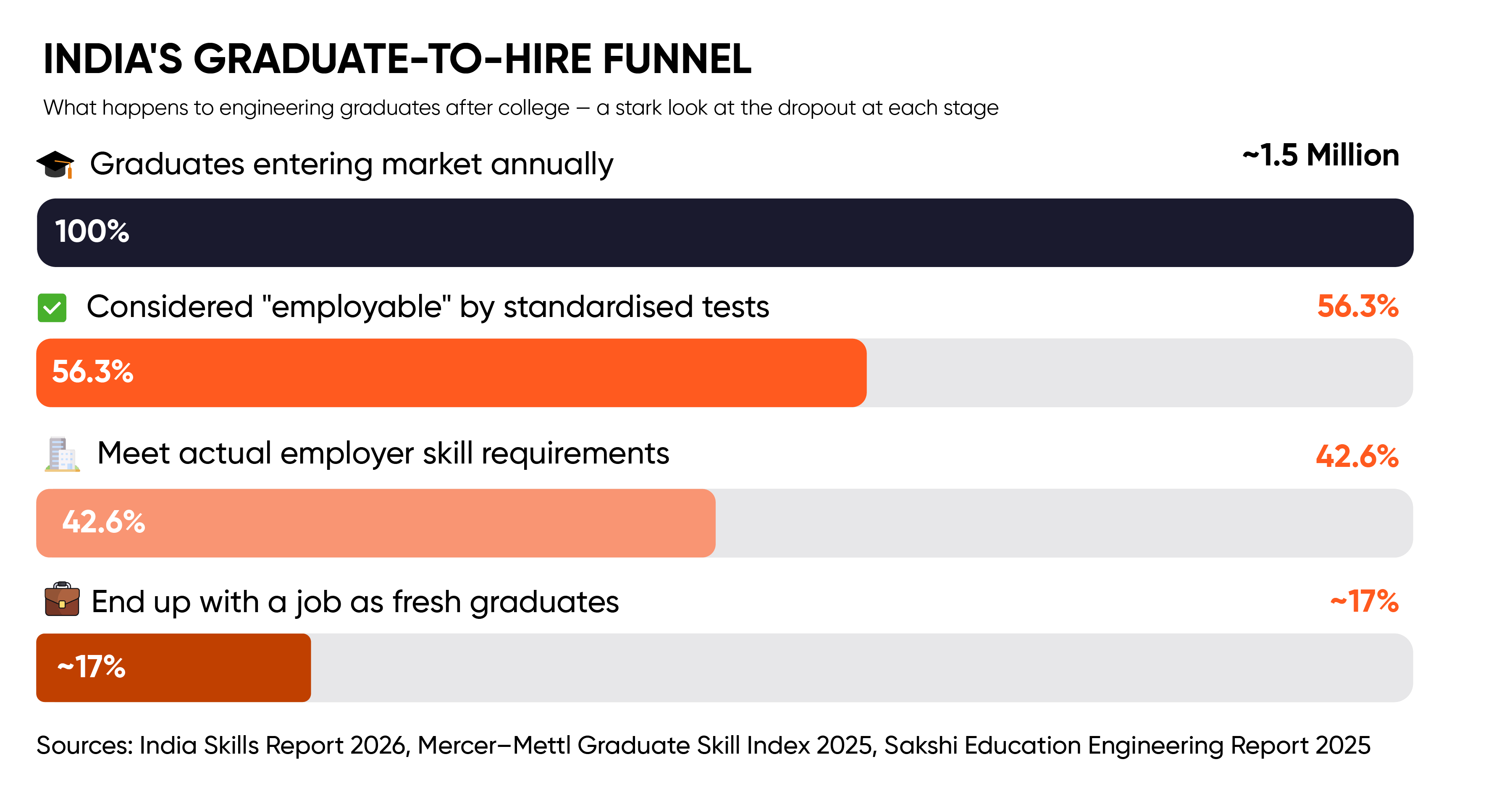
The Real Problem: It's Not a Jobs Shortage, It's a Skills Mismatch
The fresher hiring trends India 2026 reveal something counterintuitive: 80% of employers in India struggled to find skilled professionals in 2025, above the global average of 74%, even while actively recruiting for entry-level jobs in India 2026.
So where's the disconnect? It lives in four specific areas:
- Communication gaps: 52% of graduates fail interviews due to poor spoken English or presentation skills rather than technical incompetence. Employers now rank "Integrity & Values" (39%) higher than coding proficiency in hiring criteria.
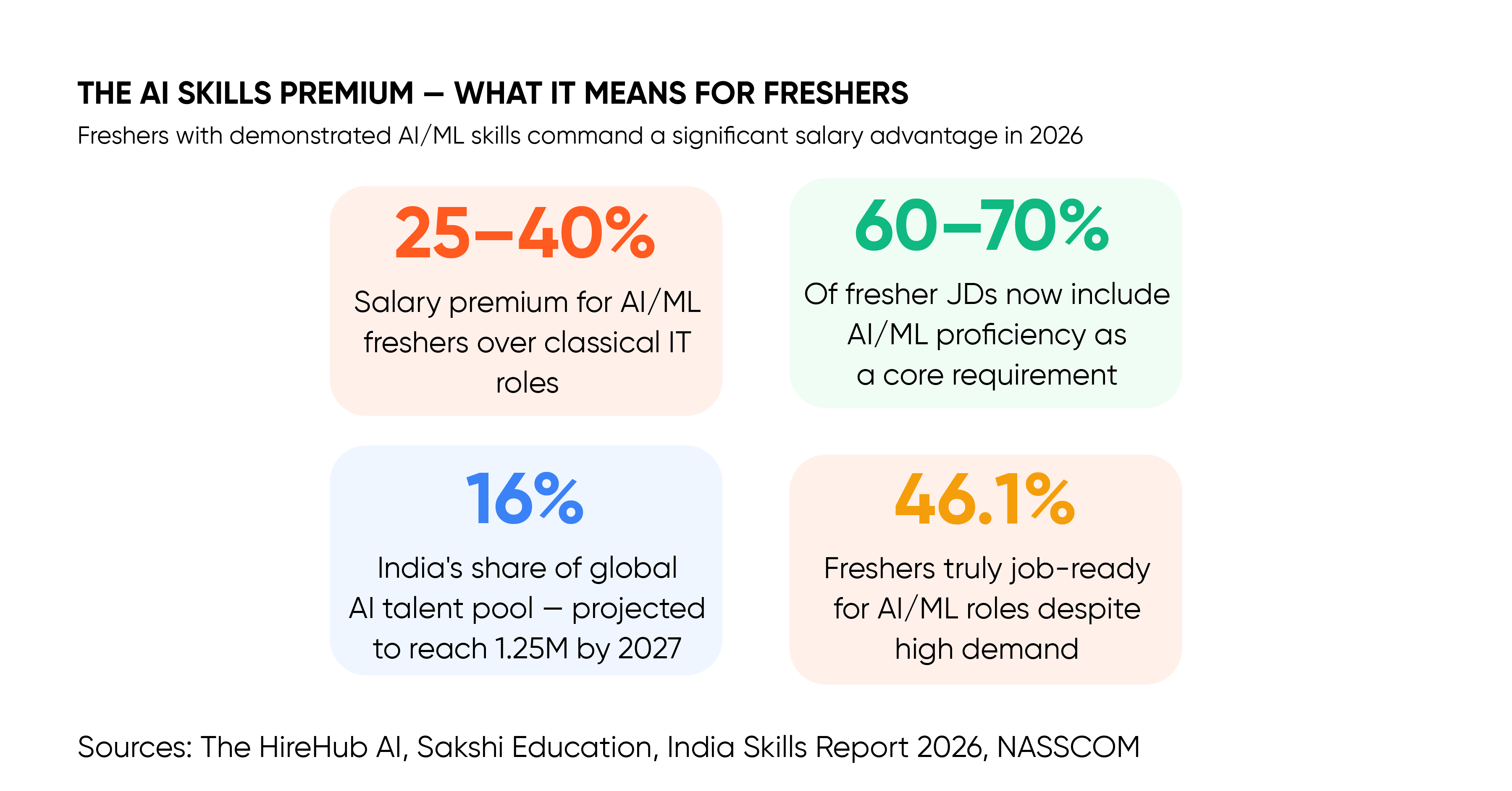
- AI blindspot: 60–70% of fresher job descriptions now require AI/ML proficiency. Only a fraction of graduates from non-IIT colleges have meaningful exposure.
- Portfolio vs. marksheet culture: 65% of freshers believe a degree alone qualifies them for a high-paying job. Only 30% have pursued any certification or hands-on training beyond coursework.
- CGPA filters fading, skills filters rising: Removing CGPA thresholds expands the candidate pool by 40–50% when paired with robust skills assessments, yet most freshers haven't built that proof of skills.
NASSCOM Note:
India's technology sector requires over 1 million engineers with advanced AI skills in the next 2 to 3 years. The demand-supply gap for digital talent is expected to widen from the current 25% to nearly 30% by 2028. That gap is both a challenge and an enormous window for skilled freshers.
"Graduates know theory but cannot apply it. Universities focus on academic achievement while workplaces demand hands-on skills, digital literacy, and communication."
— Recurring feedback from hiring managers across IT, BFSI, and Manufacturing; Amazing Workplaces Survey, 2025
Which Sectors Are Actually Hiring Freshers in 2026?
Not all industries are playing the same game. Here's the sector-level picture for fresher job opportunities in India 2026, drawn from the India Skills Report and NASSCOM data:
| Sector | Fresher Hiring Share | Key Roles | Avg. Fresher Salary | Trend |
| IT / Software | 35% | SDE, Data Analyst, QA | ₹3.5–8 LPA | Strong |
| BFSI / Fintech | 18% | Credit Analyst, KYC, Sales Officer | ₹3–5 LPA | Growing |
| Manufacturing / PLI | 82% intent* | Production, Quality, Robotics | ₹2.5–4.5 LPA | Rapidly expanding |
| Healthcare / Pharma | 12% | MR, Clinical Research, Lab Tech | ₹2.5–4 LPA | Steady |
| GCCs (Global Capability Centres) | 40% increase planned* | Analytics, Cloud, Product | ₹5–12 LPA | Highest packages |
| Digital Marketing | 9% | SEO, Content, Performance | ₹2.4–5 LPA | Stable |
| Renewable Energy | Emerging | Solar Tech, Project Coordinator | ₹3–5 LPA | New frontier |
*Hiring intent figure for manufacturing. GCC figures from NASSCOM/Zinnov 2025. Salary figures are approximate entry-level ranges across metro locations.
Fresher Salary Benchmarks in India: 2026 Reality Check
The average fresher salary in India 2026 is impossible to state as a single number. It varies dramatically by role, company tier, and city. Here's a realistic breakdown for campus placement trends 2026:
| Role | Service-based / Tier-2 Co. | Product / GCC / MNC | Top-tier (IIT / BITS) |
| AI / ML Engineer | ₹8–12 LPA | ₹18–28 LPA | ₹30–60 LPA+ |
| Software Developer | ₹3.5–6 LPA | ₹8–14 LPA | ₹18–35 LPA |
| Data Analyst | ₹4–6 LPA | ₹8–12 LPA | ₹14–22 LPA |
| Cloud / DevOps | ₹5–8 LPA | ₹10–16 LPA | ₹18–28 LPA |
| BFSI / Credit Analyst | ₹3–4.5 LPA | ₹5–8 LPA | ₹10–15 LPA |
| Digital Marketing | ₹2.4–4 LPA | ₹4–7 LPA | ₹7–12 LPA |
Note: Tier-2/3 city locations typically see 5–15% lower salary packages. Figures reflect 2026 market data from AmbitionBox, HireHub AI, and NASSCOM salary benchmarks.
The Geography Shift: Tier-2 Cities Are No Longer a Fallback
One of the most significant and underreported trends in the fresher job market in India 2026 is geographic diversification. While Tier-1 cities still account for 88–90% of IT demand, Tier-2 and Tier-3 cities are growing at 25% annually, more than double the metro growth rate.
Cities like Lucknow, Kochi, Chandigarh, Coimbatore, Jaipur, and Ahmedabad are now listed as emerging employability hubs in the India Skills Report 2026. For fresher jobs in Tier-2 cities India, this isn't symbolic. Companies are actively setting up delivery centres and GCC satellite offices outside metros to access lower-cost, underserved talent pools.
Regional Insight:
Top 3 states by employability in 2026: Uttar Pradesh, Maharashtra, and Karnataka. Tier-2 city freshers are now 40–50% more accessible to recruiters who've dropped CGPA filters in favour of skills assessments, opening a huge, previously untapped pipeline.
Women Freshers: A Historic Shift in Employability
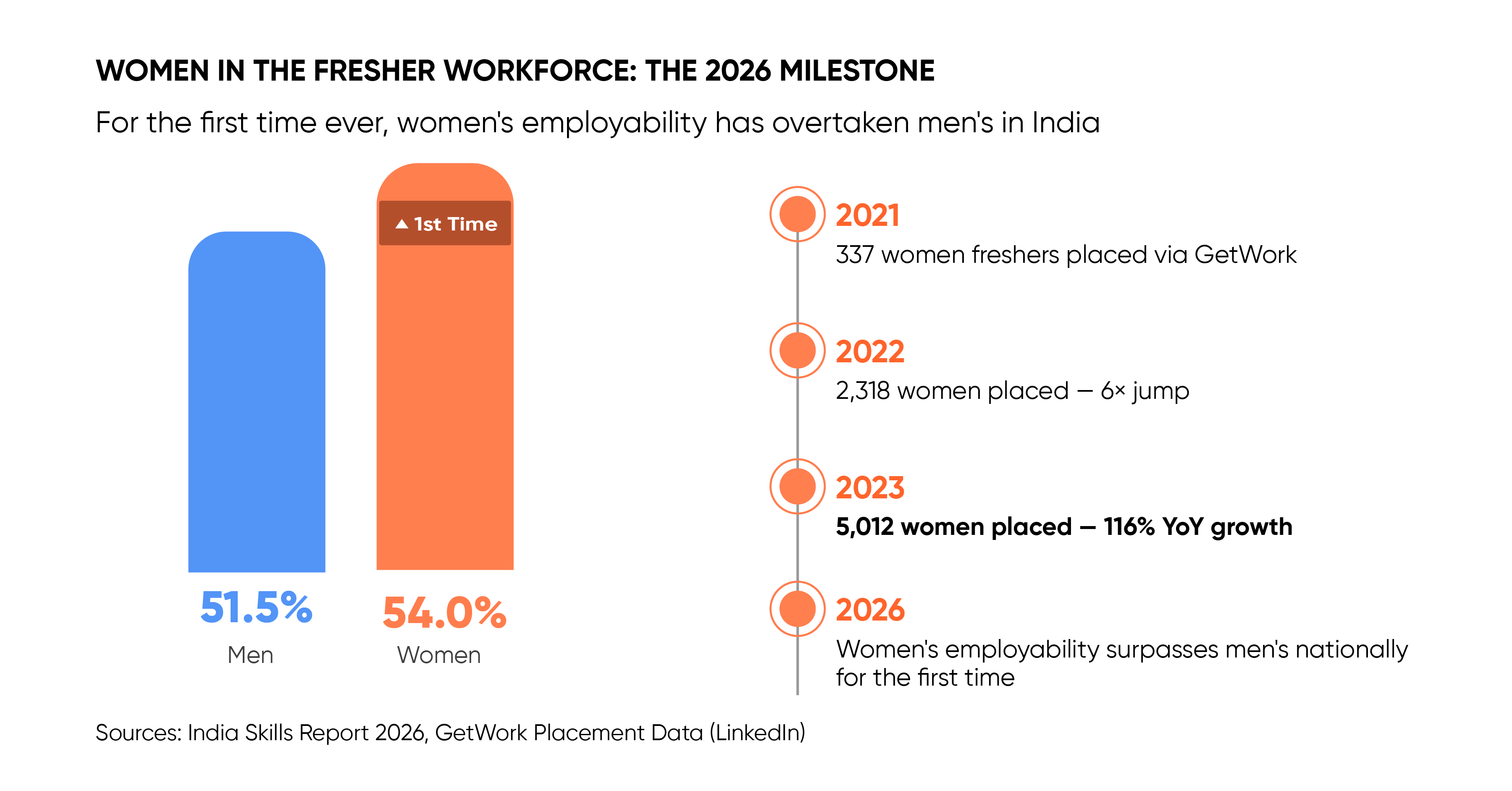
The India Skills Report 2026 recorded a first: women's employability (54%) surpassed men's (51.5%) for the first time in years. This isn't a rounding error; it reflects a genuine structural change driven by hybrid work models, digital skilling access, and growing acceptance in sectors like BFSI, education, and healthcare.
GetWork's own placement data shows the momentum. Female fresher placements grew 116% year-on-year in 2023, with over 5,000 women placed across Tier-2 and Tier-3 colleges, up from just 337 in 2021. Sectors like IT-enabled services, professional services, and BPOs are leading that hiring surge.
What Is GetWork Doing Differently? And Why It's Working?
Most online job portals for freshers are essentially notice boards. You upload a resume, apply to 200 listings, and wait. The average time to hire on conventional platforms is 2–3 months.
GetWork was built on a different premise. The problem isn't that jobs don't exist; it's that the connection between freshers and recruiters is broken.
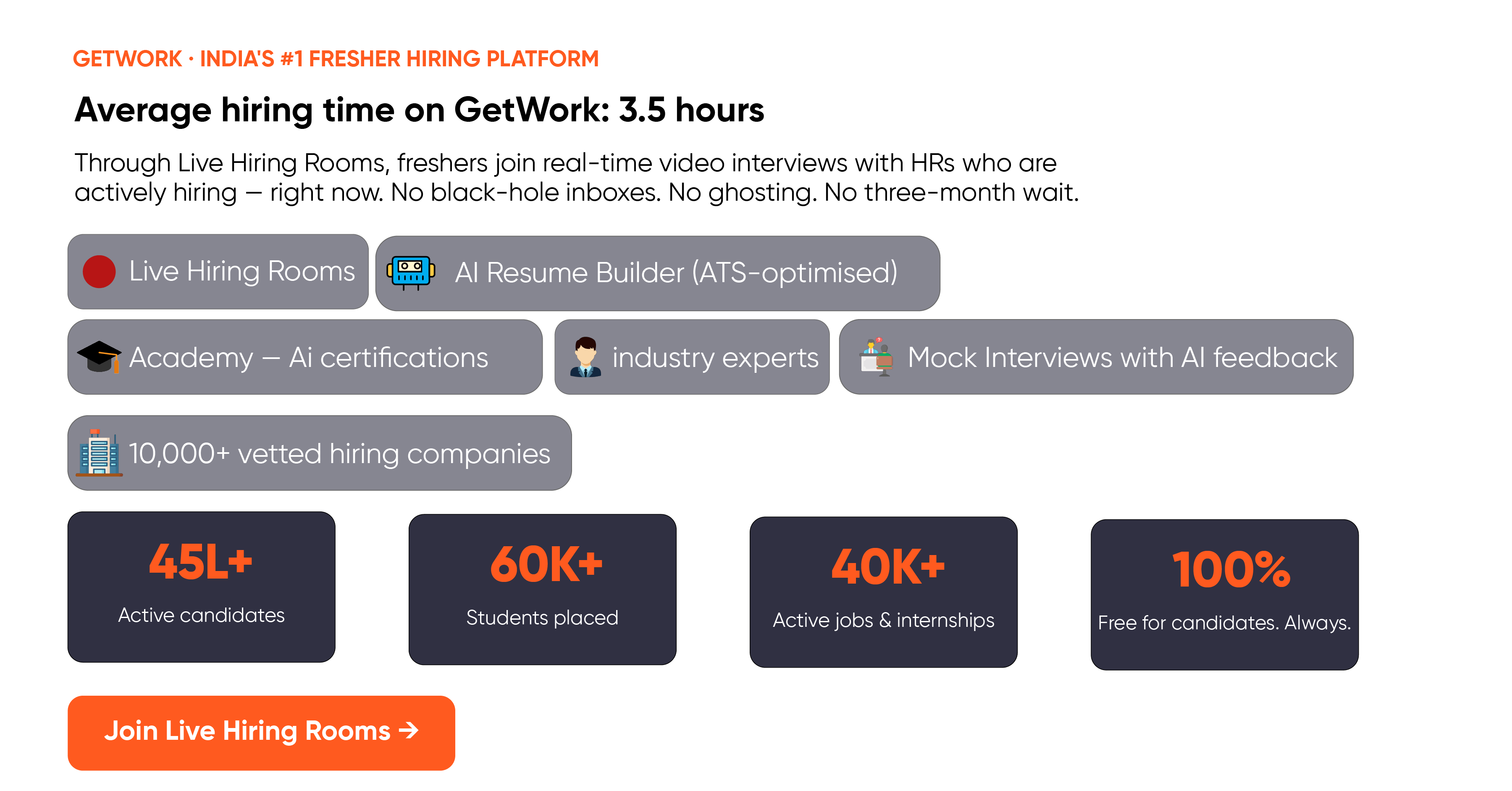
The Live Hiring Room model specifically addresses what the data highlights as the top barrier: the "resume black hole." Rather than sending applications into a void, freshers walk into a real conversation with an active recruiter: reducing anxiety, cutting time-to-offer, and giving first-generation job seekers the same access that comes naturally to those with strong networks.
What Freshers Should Actually Do Right Now
The how to get a job as a fresher in India 2026 question doesn't have a magic answer, but the data points to clear actions:
1. Build proof, not just a degree
A GitHub portfolio, a Kaggle competition entry, a Tableau dashboard, or a Google Ads campaign run for a college project — all of these outperform a 9 CGPA on a resume when a recruiter is using AI screening. Skills-based hiring has moved from rhetoric to reality: 80% of employers now prioritise project-based expertise over formal degrees (Zyoin, 2026).
2. Get certified on platforms employers recognise
AWS, Google (Analytics, Ads, IT Support), Microsoft Azure, NASSCOM FutureSkills, and platforms like GetWork's AIcademy offer credentials that recruiters at large companies actively look for in fresher profiles. Only 30% of graduates have done this, which means it's a meaningful differentiator for those who do.
3. Stop filtering by brand name
The biggest cognitive trap for freshers: holding out for an MNC while ignoring strong SMEs, startups, and GCC satellite offices that are actively hiring and often offer faster growth. The first-time job seeker India who joins a 200-person fintech company and touches real problems in month one will outpace the fresher waiting nine months for a belated MNC offer.
4. Prepare for AI-powered screening
70% of IT companies and 50% of BFSI firms now use AI in their hiring process. That means ATS-friendly resumes for freshers, skills-keyword optimisation, and readiness for video interviews are no longer optional. Tools like GetWork's AI Resume Builder and Mock Interview module are designed specifically for this.
The Bottom Line
The fresher job market in India 2026 is not broken. It is bifurcated. On one side: a growing demand for skilled, AI-fluent, portfolio-backed, communication-ready graduates across IT, BFSI, GCCs, and manufacturing. On the other: millions of graduates still betting that a degree certificate alone will open doors and then finding that it won't.
The data is consistent across every credible source: employability is rising, but the gap between "employable on paper" and "hired in practice" remains large. The freshers who close that gap with the right skills, the right platforms, and the willingness to start before they feel 100% ready are the ones who are landing offers today.
GetWork exists at that intersection. It doesn't just list jobs. It connects verified, active recruiters with freshers in real time, removes the waiting and the guessing, and equips candidates with AI-powered tools they need to walk into every conversation with confidence. 60,000+ students placed. 10,000+ hiring companies. 3.5 hours to hire on average.
The market has moved. The question is whether you have too. Join GetWork. It's 100% Free for Freshers.
Frequently Asked Questions
It's genuinely mixed. Hiring intent among employers has jumped to 40% for FY 2026–27 (up from 29% the year before), and sectors like IT, GCCs, and manufacturing are actively expanding entry-level positions.
However, freshers' share of total hires has dropped to 14% (from 18.8% in 2024), because companies are raising the bar. Freshers with demonstrable skills, certifications, and a strong digital presence are finding opportunities quickly. Those who rely solely on their degree are struggling.
It varies significantly by sector and company type. In service-based IT companies, freshers typically earn ₹3.5–6 LPA. In product companies, GCCs, or fintech, packages of ₹8–14 LPA are common. AI/ML freshers with strong portfolios charge ₹18–28 LPA at mid-tier product companies and up to ₹60 LPA+ at top-tier research labs. Non-tech sectors like BFSI and marketing typically range from ₹2.5–5 LPA at the entry level.
Based on hiring volume, salary growth, and long-term outlook: AI/ML and Data Science offer the highest packages; GCCs (Global Capability Centres) plan a 40% increase in fresher hiring with strong compensation; BFSI and fintech are expected to generate 2.5 lakh new jobs by 2030; manufacturing under the PLI scheme shows 82% hiring intent for freshers; and renewable energy is an emerging frontier. IT software development remains the largest in volume.
Traditional campus placements relied heavily on CGPA thresholds and college brand. In 2026, this model is shattering. Companies that removed CGPA filters in favour of practical assessments expanded their candidate pools by 40–50% while improving quality-of-hire.
70% of IT companies and 50% of BFSI firms now use AI-powered recruitment tools. This means freshers need a GitHub profile, certifications, and demonstrated project work, not just a marksheet. Platforms like GetWork are built for this reality, matching candidates by skill signals rather than degree credentials.
GetWork solves the single biggest pain point freshers face: the resume black hole. Through its Live Hiring Rooms, freshers connect directly with HRs via real-time video with an average wait time of just 8 minutes and an average time-to-hire of 3.5 hours vs. 2–3 months on traditional portals. It's entirely free for candidates.
Beyond job matching, GetWork provides an AI resume builder, mock interview prep, AI-powered certifications and 1-on-1 mentorship by Aicademy, everything a fresh graduate needs to land that first offer. With 60,000+ students placed and 10,000+ verified companies, it's India's only complete fresher hiring ecosystem.


0

