
AI Is Not Replacing HR. It's Replacing HR Professionals Who Don't Use AI

There is a conversation happening inside every HR team right now. In boardrooms in Mumbai, in open-plan offices in Bengaluru, in HR pods in Gurugram. It is not about whether AI will arrive. It already has. The real question is whether you will be on the right side of what happens next.
Let's be direct about what is at stake. AI in HR is not a trend to watch from a safe distance. It is a fundamental reordering of who does what inside a people function. The organisations that get this right will hire faster, retain better, and build workforces that actually move the needle. The professionals who get this wrong will find that their role, as they currently perform it, has a shrinking shelf life.
- 43% of organisations now use AI in HR tasks
- 7,800+ HR jobs at IBM earmarked for AI automation
- 3.5 hrs saved per week per HR professional using AI
- 72% of TA leaders plan to upskill teams on AI tools
But here is the truth that gets lost in the panic. AI cannot do what human resources requires. It cannot sit across a table from a distressed employee. It cannot read the room when a performance conversation turns personal. It cannot defend a hiring decision on the grounds of gut, culture, and intuition honed over a decade. What AI can do and is doing right now is take over every single task that does not require those things.
The HR professionals who understand this distinction are not worried. They are winning. This blog is for both groups. A clear, data-backed look at where artificial intelligence in human resources stands today, what it will take away, what it will amplify, and the exact upskilling roadmap that separates those who adapt from those who don't.
Is AI Really Taking Over Human Resources? Or Is That Just Fear-Mongering?
AI is replacing HR professionals who perform routine, process-driven work. Simultaneously, it is creating demand for HR professionals who can think, strategise, and manage AI systems themselves.
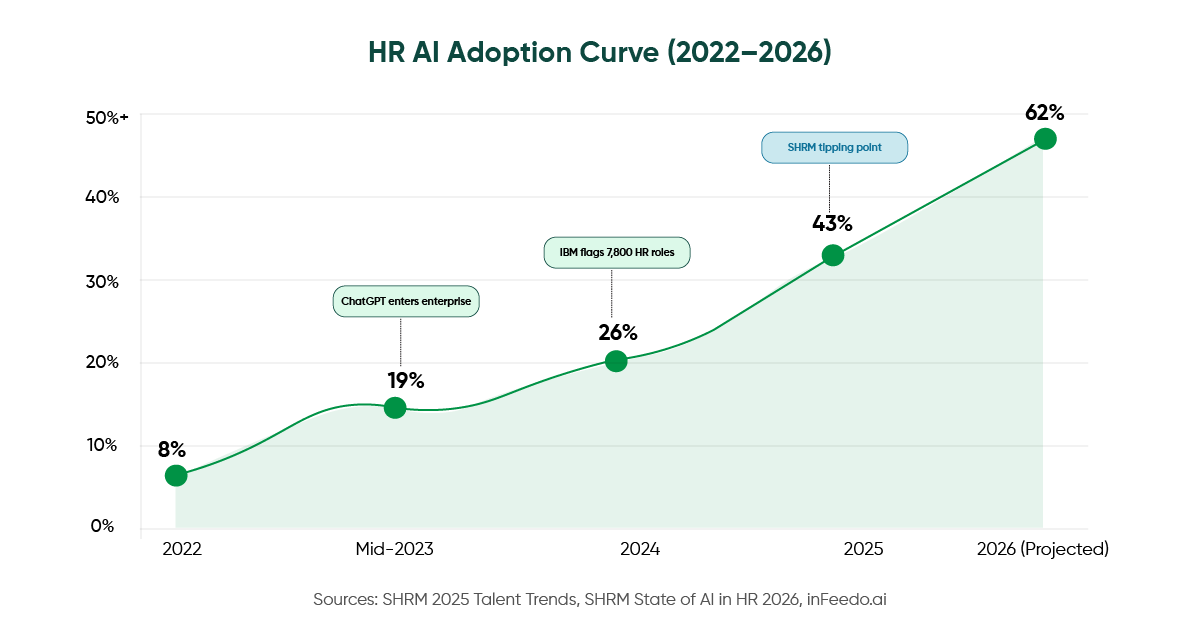
The data from the SHRM 2025 Talent Trends report is straightforward. HR automation has crossed a tipping point:
| 43% of organisations used AI in HR tasks in 2025, up from 26% in 2024 (SHRM, 2025) | 61% of HR departments adopted generative AI by January 2025, up from 19% in mid-2023 (SHRM / inFeedo) | 73% of HR directors and above had adopted AI by 2025 (SHRM State of AI 2026) | 51% of organisations use AI specifically to support recruiting, the most common HR use case (SHRM, 2025) |
And yet, only 1% of HR departments currently use AI at an advanced level. Most organisations are in the early stages of figuring this out. That gap between adoption and mastery is where careers are being built and lost right now.
"The question is not whether AI will change your HR role. It has already begun. The question is whether you will be the person who leverages the change or the one it leaves behind."
IBM made this shift visible in 2023 when it paused recruitment for roles it believed AI recruitment automation could handle, flagging up to 7,800 positions for potential replacement. This was not a headline-chasing move. It was a corporate roadmap made public.
Which HR Tasks Is AI Already Doing And Should You Be Worried?
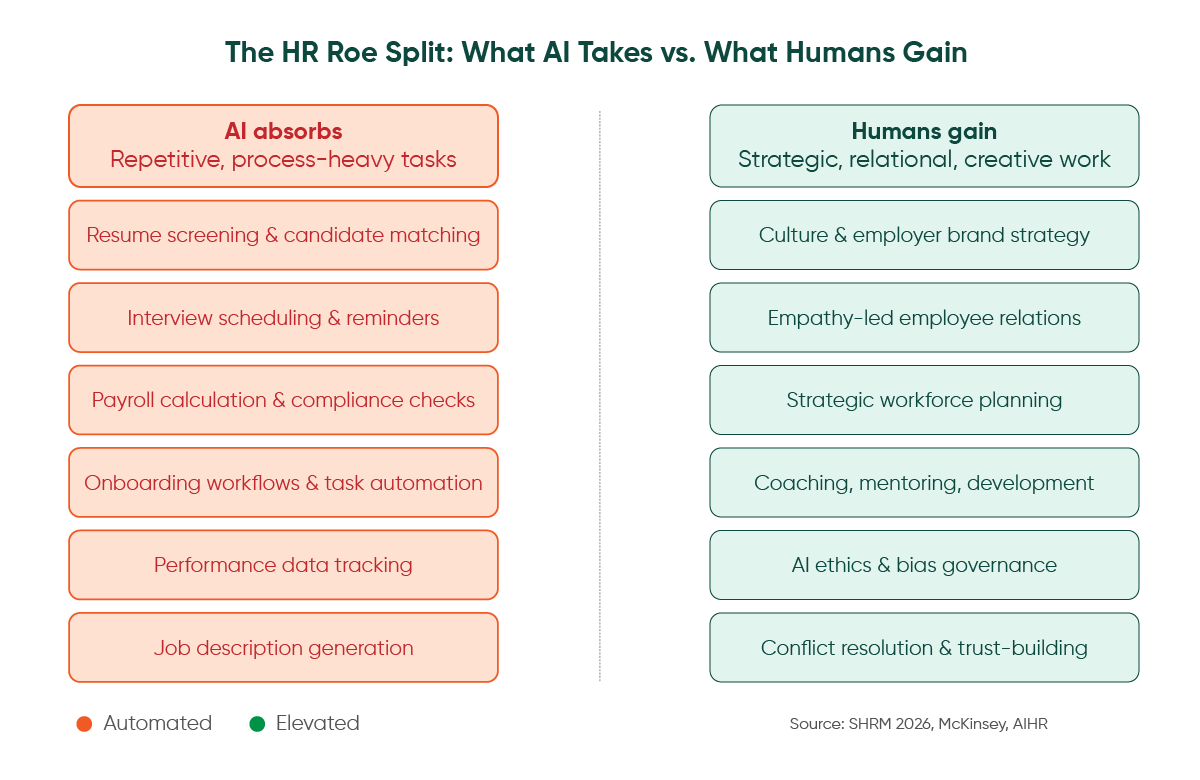
Worry is not the right frame. Clarity is. Here's a breakdown of what AI can handle in HR and what still requires human involvement.
| HR Function | What AI Handles Today | What Stays Human | Risk Level for Professionals |
| Recruitment & Sourcing | Resume screening, job description generation, candidate matching, interview scheduling, automated outreach | Final candidate judgement, culture-fit evaluation, offer negotiation, relationship building | High for admin-only recruiters |
| Onboarding | Workflow triggers, document collection, system access provisioning, FAQ responses | Welcoming culture, manager introductions, first-impression relationship | Medium |
| Performance Management | Real-time tracking, feedback generation, sentiment analysis, disengagement alerts | Coaching conversations, difficult feedback, development planning | Medium |
| Payroll & Compliance | Calculations, tax processing, labour law monitoring, error detection, pay equity analysis | Exceptions, disputes, policy interpretation, employee trust | High for pure payroll operators |
| Learning & Development | Skills gap identification, personalised course recommendations, progress tracking | Learning culture building, mentoring, career conversations | Medium |
| Employee Relations | Sentiment monitoring, early disengagement signals, policy document generation | Conflict resolution, confidential conversations, empathy-driven support | Low as it is deeply human |
| Workforce Planning | Predictive headcount modelling, attrition risk scoring, succession analytics | Strategic business alignment, leadership development, organisational design | Low as it is enhanced by AI, not replaced |
The pattern is consistent. AI candidate screening, AI-driven payroll, and HRIS automation are wiping out the repetitive, process-heavy version of HR roles. But the consultative, relationship-driven, and strategically complex dimensions of this work are not just safe, but they are becoming more valuable.
What Does the WEF's Future of Jobs Report Really Say About HR?
The World Economic Forum's Future of Jobs Report 2025 predicts that by 2030, 92 million jobs will disappear, but 170 million new jobs will be created, resulting in a net gain of 78 million jobs worldwide.
For HR and people functions specifically, 41% of employers globally plan to reduce their workforce where AI can automate tasks. At the same time, 70% plan to hire for new AI-related skills. This is not a contradiction. It is a workforce being split in two.
Key Findings of WEF 2025 for HR Professionals
- 39% of key job skills will change by 2030, down from 44% in 2023, suggesting upskilling efforts are starting to close the gap.
- AI & big data skills are the fastest-growing skills, followed by technological literacy and cognitive skills.
- Talent management & leadership and social influence are both rising in importance. It is a direct signal that strategic HR skills gain value as AI takes the operational load.
- 77% of employers plan to upskill their existing workforces in response to AI disruption.
How Are HR Professionals Who Use AI Different In Practice?
This is the question that separates theoretical understanding from career-level action. The future of HR jobs does not look like a binary of "AI wins" or "humans win." It looks like this: the same HR function, but with a dramatically different ratio of time spent.
According to SHRM's 2026 State of AI in HR Report, HR professionals in AI-enabled organisations save more than 3.5 hours per week through automation. That is nearly two full working days per month recovered and redirected from paperwork to people.
Here is how that plays out on the ground:
1. Recruiting: From inbox management to talent strategy
An HR recruiter who uses AI handles resume screening in minutes instead of hours. The free time goes into candidate experience, employer branding, and building talent pipelines. The work that actually fills roles with the right people.
2. Performance: From annual reviews to real-time conversations
AI-driven sentiment analysis detects disengagement 25% faster. HR professionals using these signals can intervene proactively instead of reacting to resignations. The role becomes coaching-forward rather than form-forward.
3. Workforce planning: From spreadsheets to strategic foresight
Predictive analytics workforce planning tools now model attrition risk, identify skills gaps across business units, and forecast headcount needs. HR professionals who can interpret and act on this data move from support function to business partner.
4. Employee experience: From surveys to always-on intelligence
AI-powered feedback platforms boost employee retention by 15% by making feedback more timely and personalised. HR professionals who deploy and manage these tools become the architects of culture, not just its administrators.
Which AI Tools Should Every HR Professional Know in 2026?
You do not need to become a tech professional. You need to become a proficient human-AI collaboration practitioner. Someone who knows which tool to use, when to trust its output, and when to override it with human judgement.
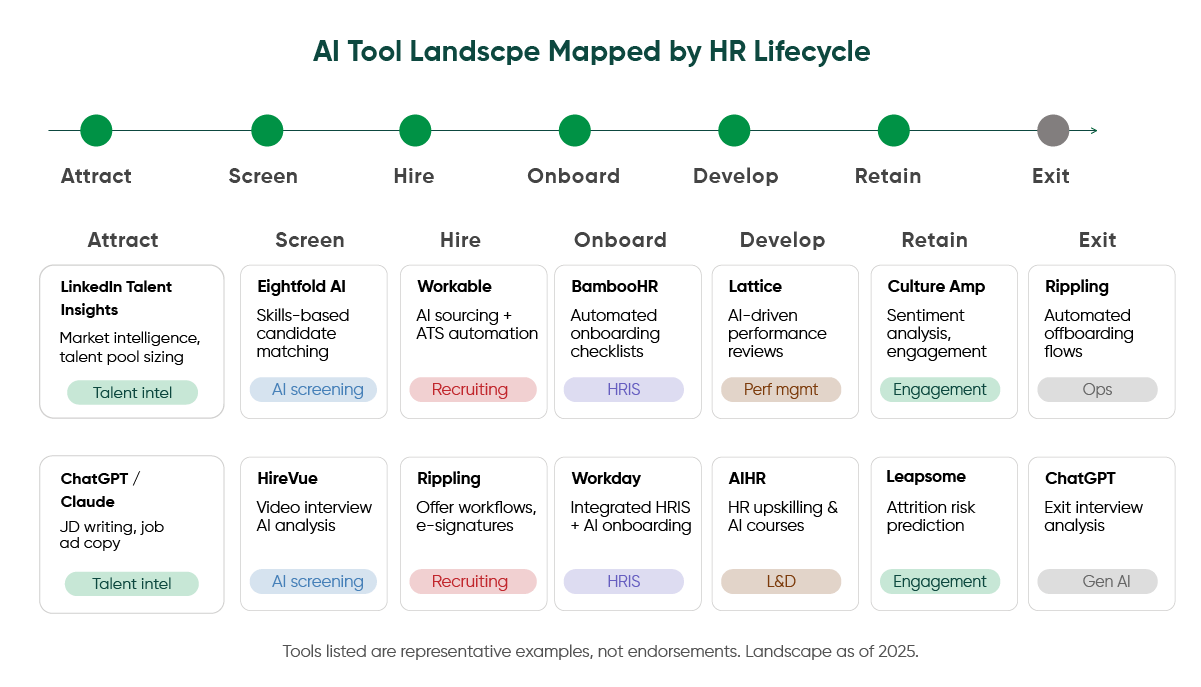
Here is a practical toolkit across the key HR functions:
| HR Function /Category | Popular Tools | What They Do |
| Generative AI | ChatGPT / Claude | JD writing, policy drafts, onboarding FAQs, training content, communication templates |
| Talent Acquisition | HireVue / Eightfold AI | AI-powered candidate screening, video interviews, skills-based matching |
| Core HR Platform | Workday / Rippling | Integrated HRIS with AI-driven payroll, compliance monitoring, performance analytics |
| Employee Experience | Lattice / Culture Amp | AI-driven employee engagement surveys, sentiment analysis, retention prediction |
| HR Operations | Personio / BambooHR | SME-focused HRIS with AI automations for onboarding, time tracking, and HR workflows |
| Talent Intelligence | LinkedIn Talent Insights | Market intelligence, talent pool analysis, competitive benchmarking for workforce planning |
Critical Heads-up: Bias Does Not Disappear With AI
Three in four HR leaders cite bias as a top concern when adopting AI. AI bias has been detected in 36% of hiring algorithms. The Workday lawsuit, where AI screening tools allegedly disadvantaged Black, disabled, and over-40 candidates, is a cautionary tale every HR professional should study. Using AI tools does not remove your responsibility for fair hiring. It amplifies it.
What Skills Do HR Professionals Need to Thrive in the AI Era?
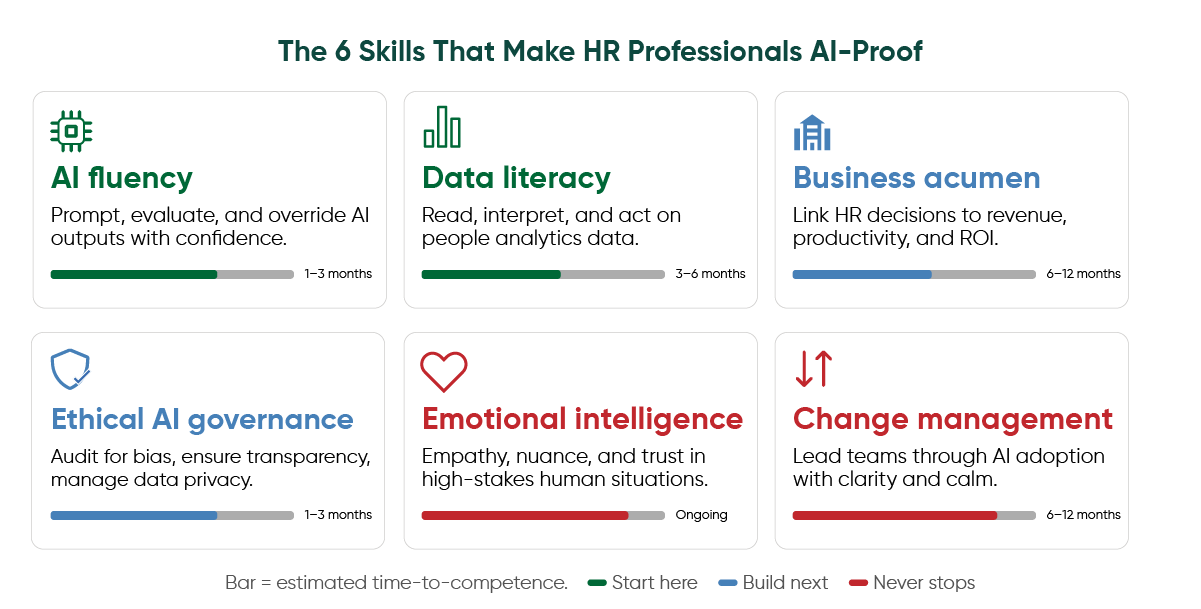
HR upskilling for AI is not about adding a line to your LinkedIn profile. It is about a genuine capability shift. The Academy to Innovate HR (AIHR) identifies the following as essential:
- AI fluency: The ability to prompt AI tools effectively, evaluate their outputs critically, and understand their limitations. This is the foundational layer which is non-negotiable for every HR professional.
- Data literacy: People analytics is no longer the exclusive territory of data teams. HR professionals who can read, interpret, and act on workforce data make strategic decisions rather than administrative ones.
- Business acumen: As AI absorbs operational HR, the function must justify its existence through business impact. HR professionals need to speak the language of revenue, productivity, and ROI.
- Ethical AI governance: Someone has to be responsible for auditing AI systems for bias, maintaining employee data privacy under laws like India's DPDP Act, and building transparency into AI-driven HR decisions. That someone is HR.
- Emotional intelligence & complex communication: The SHRM 2026 report states clearly that empathy, nuance, authenticity, and trust in handling confidential, sensitive, and high-stakes employee situations remain irreplaceable. It will matter more and more as AI handles the rest.
- Change management: AI adoption does not manage itself. Resistance, fear, and skills anxiety are human problems that require human solutions. HR professionals who can lead organisational change through technology transitions will be indispensable.
According to Gartner, organisations investing in upskilling and reskilling are 2.5 times more likely to achieve positive business outcomes from AI. The development of your own people, starting with yourself, is the most strategic investment an HR team can make right now.
How Should HR Professionals Actually Start Without Feeling Overwhelmed?
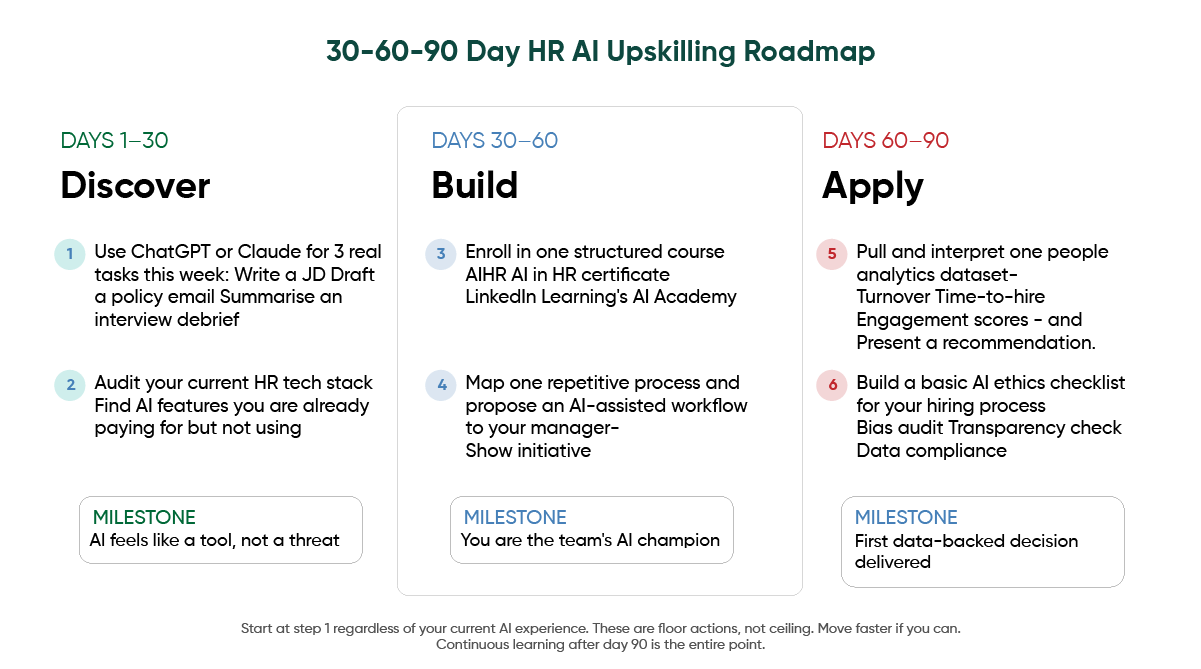
The answer is not to wait for a formal training programme or a new job title. The answer is to start small, start now, and iterate. Here is a practical 30-60-90 day roadmap:
| Timeline | Action | Goal |
| Days 1–30 | Use ChatGPT or Claude for 3 real-world tasks this week. Write a JD, draft an email, and summarise a policy document | Build AI fluency through daily practice, not theory |
| Audit your current HR tech stack. Identify what already has AI features you are not using | Unlock value from tools you already pay for | |
| Days 30–60 | Enroll in one structured course: AIHR's AI in HR certificate, LinkedIn Learning's AI Academy, or Aicademy's AI-powered program for HR Professionals | Build systematic knowledge, not just intuition |
| Map one repetitive HR process in your current role and propose an AI-assisted workflow to your manager | Demonstrate initiative; build internal credibility as an AI champion | |
| Days 60–90 | Learn the basics of people analytics. Pull and interpret one dataset (turnover, time-to-hire, engagement scores) | Make your first data-backed recommendation to leadership |
| Develop a basic AI ethics checklist for your team's hiring process. Evaluate for bias, transparency, and employee data compliance | Position yourself as an HR professional who uses AI responsibly |
This is not about becoming a tech expert. It is about becoming the HR professional who cannot be replaced by one.
What Is the Real Cost of Waiting? And Who Is Already Paying for It?
Entry-level job postings globally fell 29% since January 2024, according to Randstad's analysis of 126 million job postings. In the UK, 1.2 million graduates competed for just under 17,000 entry-level positions in 2024. In India, youth unemployment sits at 17%.
This is not an abstract future problem. The compression is already happening at the bottom of the HR career ladder, where administrative, process-heavy roles are being automated before the professionals who hold them have had time to upskill out of them.
The wave of HR digital transformation is not waiting. The professionals who are winning right now did not wait to understand AI perfectly before using it. They started using it imperfectly, learned fast, and built an advantage through iteration.
"The future of HR will be about co-working with AI, where machines handle scale and efficiency, while humans bring empathy, ethics, and vision."
McKinsey's analysis of the agentic AI future puts HR at the centre of workforce transformation. Not as a passive function managing headcount, but as the architect of how human and AI capabilities combine. That is the version of HR that will matter in 2026, 2027, and beyond.
You have a choice right now that is cleaner than it has ever been. You can be the HR professional who manages AI, or the HR professional who gets managed out by it. One of those paths requires learning. The other requires nothing, which is precisely what makes it dangerous.
Where Should You Start? How Aicademy's HRM Programme Builds an AI-Proficient HR Professional?
Knowing you need to upskill is one thing. Finding a structured, India-market-specific path to update those skills is another. Aicademy by GetWork's Human Resource Management Programme is built precisely for that gap. It is a 12-week, 80+ hour live online course that treats AI in HR not as a module, but as the operating system of the entire curriculum.
The programme is structured across four integrated courses:
- Foundations of Human Resource Practice
- Talent Discovery & Acquisition
- Talent Engagement & Branding
- HR Analytics & Technology
Each of these modules is built around real HR scenarios, not theoretical frameworks. Students work across 12+ tools, including ChatGPT, Zoho Recruit, LinkedIn Recruiter, HRIS platforms, and Microsoft Excel for HR analytics. Crucially, these tools are taught in the context of actual HR tasks, ie, writing JDs with ChatGPT, building ATS-ready hiring pipelines in Zoho, and tracking attrition using Excel dashboards.
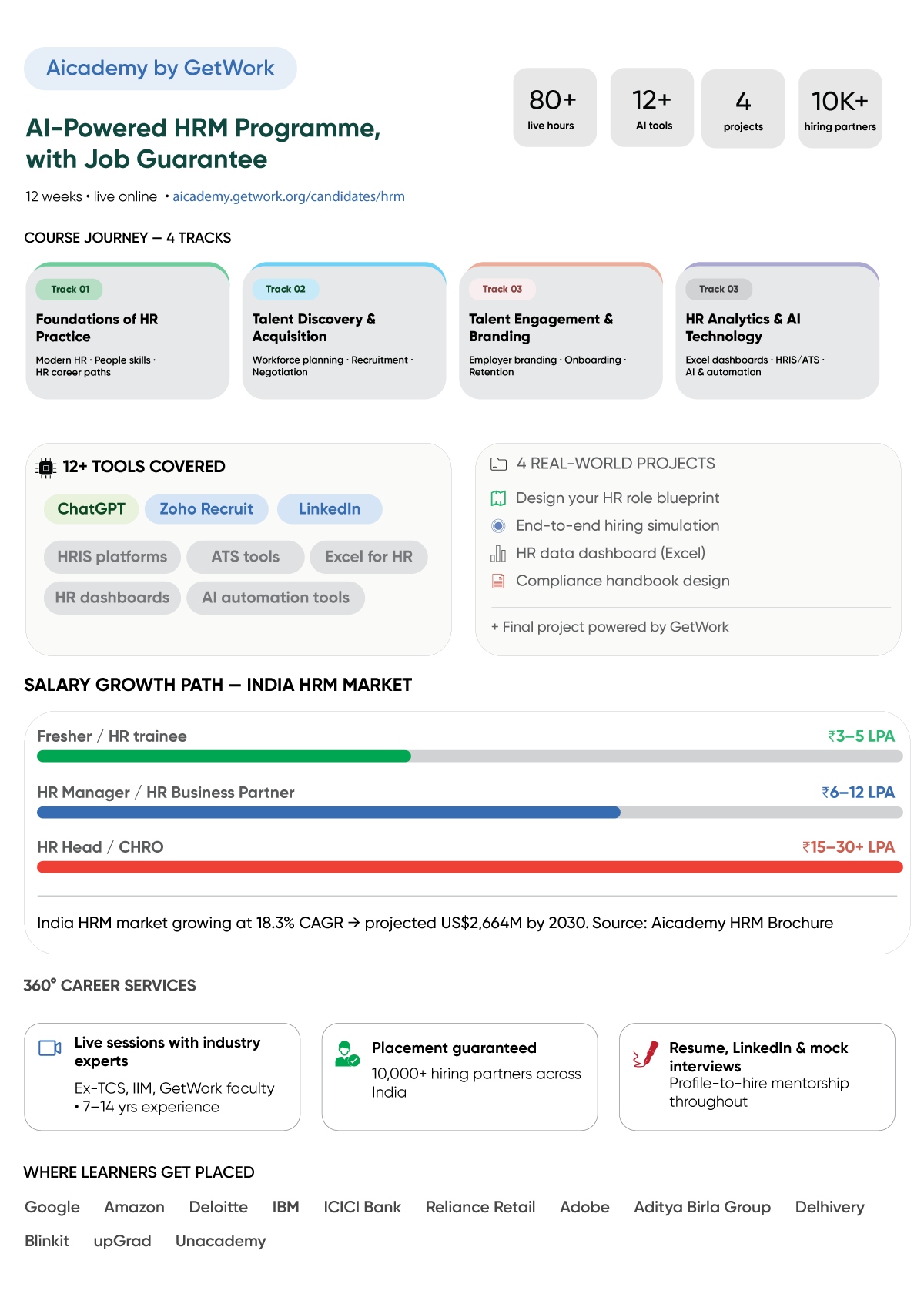
What makes the programme directly relevant to the HR upskilling AI argument is the HR Analytics & Technology module. It is a dedicated block on AI-Powered HR Tools covering ATS and HRIS overview, AI and automation in HR workflows, and data-driven decision-making through HR dashboards. This is where candidates stop being AI-curious and become AI-capable. The four hands-on projects, including an End-to-End Hiring Simulation, an HR Data Dashboard built in Excel, and a Compliance Handbook, create a portfolio that hiring managers can evaluate that certificates cannot.
The placement infrastructure is what separates this from a standalone certification. GetWork's hiring network, which has placed candidates at Google, Amazon, Deloitte, ICICI Bank, Reliance Retail, IBM, Adobe, and Aditya Birla Group, is the pipeline Aicademy students graduate into. Past learners have made transitions from BPO customer support and school teaching into HR Recruiter and Talent Acquisition Specialist roles at major firms within weeks of course completion.
The 30-60-90 day roadmap in this article and the Aicademy HRM programme are designed to run in parallel. The programme gives the roadmap its structure; the AI in HR habit you build inside it compounds long after the 12 weeks end. For freshers, career-switchers, MBA aspirants, and working professionals looking to future-proof their HR role in India's HR digital transformation wave, this is the most direct path from knowing AI matters to proving you can deploy it.
Ready to Become the HR Professional AI Can't Replace?
Aicademy's 12-week HRM Programme combines live classes, 12+ AI tools, 4 real-world projects, and guaranteed placement support across 10,000+ hiring partners built for India's AI-first job market. Enrol in the Aicademy HRM Programme →
Frequently Asked Questions
No, but AI will fully replace HR professionals who only perform repetitive, administrative tasks. The WEF's Future of Jobs Report 2025 projects a net gain of 78 million jobs globally by 2030 due to AI. Within HR, AI will automate resume screening, payroll processing, compliance monitoring, and onboarding workflows.
The roles that will survive and grow are those requiring empathy, strategic judgement, ethical oversight, and human relationship management. The profession is not disappearing; it is bifurcating into those who adapt and those who don't.
For immediate, practical impact without a steep learning curve, start with generative AI tools like ChatGPT or Claude for writing job descriptions, drafting communications, and building onboarding FAQs. For recruiting, explore HireVue, Eightfold AI, or Workable's AI sourcing features.
For employee engagement and retention analytics, Culture Amp and Lattice offer accessible AI-driven dashboards. Your existing HRIS (Workday, Rippling, BambooHR) likely already has AI features you are not using. Audit these first before buying new tools. Build fluency with tools that solve a real pain point in your current role.
AI bias has been found in 36% of hiring algorithms and has led to legal action (see the Workday bias lawsuit). To guard against it:
- Audit AI tools before deploying them. Ask vendors for bias audits and transparency reports
- Use anonymised screening that removes demographic signals from early evaluation
- Apply a diversity and inclusion lens to all AI-generated shortlists before proceeding
- Keep humans in all final hiring decisions. Don’t completely automate the candidate rejection
- Review outcomes data regularly for demographic patterns. Ethical AI governance is becoming a core HR competency, not an optional extra.
You do not need to code or build AI models. You need to become a competent user and critical evaluator of AI tools. Practical starting points include:
- Use ChatGPT daily for real HR tasks; learn by doing
- Enroll in Aicademy’s AI in HR programme, which is designed specifically for non-technical HR professionals
- Take LinkedIn Learning's AI Academy courses (launched 2025 specifically for recruiters and HR teams)
- Follow HR tech publications like SHRM, AIHR, and People Matters for applied knowledge
- Build a basic understanding of how large language models work, so you can evaluate outputs intelligently.
Three months of consistent practice will create measurable competence.
Yes, and it is increasingly accessible. AI adoption among small businesses rose from 39% in 2024 to 55% in 2025, according to a 2025 survey of small-business decision-makers. Tools like BambooHR, Personio, greytHR (popular in India), and Keka offer AI-assisted HR features at SME price points.
Generative AI tools like ChatGPT are essentially free for early-stage use and can immediately improve the quality of your JDs, policies, and candidate communications. The AI advantage is no longer reserved for large enterprises. Indian SMEs that embed AI into their HR operations now will build a compounding advantage in talent quality and retention.
Several new and growing roles are emerging at the intersection of HR and AI. Some of them include:
- HR AI Specialist: manages AI tool implementation, audits outputs, and trains HR teams on AI usage
- People Analytics Manager: translates workforce data into strategic decisions
- Talent Intelligence Analyst: uses AI-powered talent intelligence platforms to map external talent markets
- Employee Experience Designer: uses AI insights to architect high-retention employee journeys
- Organisational Change Manager: helps workforces transition through AI adoption.


0

